
Blog

Risk Financing Strategies for Smarter Business Protection
The best way to approach risk financing is to decide deliberately which losses your business will retain and which it will transfer, then measure total cost of risk, layer the program, fund the retained portion, and review it at every renewal. The market makes this a good time to ask: Marsh reported that global commercial insurance rates fell 5% in the third quarter of 2026 and property rates fell 10%, while casualty rates rose 1% and U.S. excess casualty rose 13%. A softer market gives buyers room to revisit structure, but your financial capacity, documented loss control, and contract requirements decide how much risk is safe to keep. [1] [3]
Key Takeaways
- Every insurance program already answers the retention question. Make the answer deliberate instead of letting the cheapest renewal quote decide it.
- Most businesses retain the frequent, lower-severity losses they can forecast and transfer the rare, severe losses they cannot afford.
- Judge a program on total cost of risk (premium, retained losses, loss control, and administration), not on premium alone.
- The market is split. Marsh reported property, cyber, and financial lines softening in Q3 2026 while casualty rose, so structure deserves a fresh look at renewal.
- Every retention is a promise to pay. Test it against a realistic bad year and against lease, lender, and customer contract requirements.
- Documented loss control lets a business safely keep more risk, because an underwriter can only credit what the file shows.
- Infinity Insurance Partners supports retention decisions with exposure analysis, retention analysis, and claims analysis.
Introduction
Every commercial insurance program answers a question, whether anyone asks it out loud: which losses will the business pay for itself, and which will it hand to an insurer? A deductible is an answer. So is a self-insured retention, a large deductible plan, a retrospectively rated policy, or a captive. When nobody chooses deliberately, the answer still gets given, usually by whichever quote looks cheapest at renewal.
That question sits at the center of risk financing, the set of techniques a business uses to pay for losses by retaining them, transferring them, or combining both. Getting it right takes more than shopping for a lower premium. It means matching the losses you retain to the cash you can actually mobilize, the loss control you can document, and the terms underwriters are offering. This guide walks through the main structures, the market data shaping the decision in late 2026, and a framework and checklist you can use before your next renewal.
Infinity Insurance Partners helps businesses approach this decision with exposure, retention, and claims analysis, so retention levels are tested against real loss history and real cash capacity rather than a discount alone.
What the research suggests
- Planned retention: IRMI describes planned retention as the retention of losses by an organization “as a result of a conscious decision.” A business that tests a deductible against its cash flow has made a planned retention. One that discovers an exclusion when a claim arrives has made an unplanned one. [5]
- Market pricing: Marsh reported that global commercial rates fell 5% in Q3 2026 while U.S. excess casualty rose 13%, so the room to restructure differs by line of coverage. [1] [3]
- Long-tail obligations: Risk Management magazine notes that workers’ compensation claims are long-tail, often paid out over seven to 10 years, so a retained obligation can outlast the policy year by a wide margin. [9]
- Alternative structures: a Captive.com report on Business Insurance’s 2024 Captive Domicile Rankings counted 6,290 licensed captives worldwide, excluding micro-captives, series captives, and individual cells within protected cell companies. Any captive still warrants a feasibility study. [12]
Risk financing should be treated as a balance-sheet decision, not a renewal-day price comparison. If the business has not tested what it can fund, a lower premium may simply move volatility onto its cash and credit line. A broker can help at that point by putting loss history, exposure data, and several retention options side by side. This guide explains how to approach risk financing with that mindset. Published figures are identified as such, and the framework and checklist are working tools, not industry standards.
What Is Risk Financing, and How Do Retention and Transfer Fit Together?
Risk financing is how a business pays for losses, either by retaining them, transferring them, or combining both. Retention means the business funds the loss. Transfer means someone else does, most often an insurer under a policy or a contractor under an indemnity agreement.
The word that matters in IRMI’s definition of planned retention is conscious. A business that selects a deductible after testing it against its cash flow has made a planned retention. A business that discovers an exclusion only when a claim arrives has made an unplanned one. [5]
At one end of the spectrum sits what IRMI calls complete retention, in which the organization assumes the entire risk of loss instead of transferring it to an insurer. At the other end sits a fully insured, guaranteed cost program. Most businesses land in between. They retain the frequent, lower-severity losses they can forecast and transfer the rare, severe losses they cannot afford.
Two terms help frame the trade-off:
- Premium versus volatility. Retaining a layer of predictable loss can reduce the premium you pay, but it moves volatility onto your balance sheet. The insurer’s price falls and your exposure to a bad year rises.
- Total cost of risk. This is the full cost of carrying risk: insurance premium, retained losses, and the expense of loss control and administration. Judging a program on premium alone leaves out the retained losses and the cost of managing them.
What the Market Data Says Right Now
Pricing conditions determine how much room a buyer has to restructure. Marsh’s Global Insurance Market Index, released October 21, 2026, showed global commercial insurance rates falling 5% in the third quarter, a smaller decline than the 6% recorded in the second quarter. Property rates fell 10% globally. Casualty rates rose 1% globally, driven largely by the U.S., where casualty rates rose 6%. [1] On Marsh’s October 15 earnings call, president and CEO John Doyle put U.S. excess casualty rates up 13%, which he attributed to inflationary pressure and loss costs. [3]
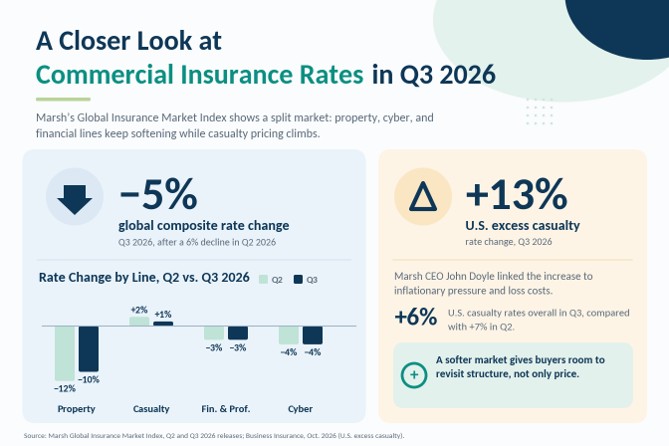
Published Industry Indicators
| Indicator | Q2 2026 | Q3 2026 | Source |
| Global composite rate change | −6% | −5% | Marsh Global Insurance Market Index |
| Global property rate change | −12% | −10% | Marsh Global Insurance Market Index |
| Global casualty rate change | +2% | +1% | Marsh Global Insurance Market Index |
| U.S. casualty rate change | +7% | +6% | Marsh Global Insurance Market Index |
| Global financial and professional lines rate change | −3% | −3% | Marsh Global Insurance Market Index |
| Global cyber rate change | −4% | −4% | Marsh Global Insurance Market Index |
Read the table as a split market. Property, cyber, and financial lines are softening while casualty keeps climbing, with U.S. excess casualty up 13% in the third quarter. Sources: Marsh’s Q2 2026 release, dated July 23, 2026 [2], and its Q3 2026 release, dated October 21, 2026 [1]. The U.S. excess casualty figure comes from Business Insurance’s coverage of Marsh’s October 15 earnings call [3]. Insurance Journal has noted that the index skews toward larger account business, so small and mid-sized companies may see different results. [4]
The Marsh releases add detail that matters for retention decisions. In Q3, Marsh said enhanced coverage terms, higher limits, and lower deductibles were achievable for clients renewing policies, and that many cyber buyers used added capacity to broaden coverage and lower retentions. [1] In Q2, John Donnelly, President, Global Placement at Marsh Risk, observed that insurers were differentiating themselves through broader coverage, expanded policy terms, and lower deductibles, and that many organizations continue to invest in alternative risk strategies, including captives. [2]
The practical reading is that a softer market gives you room to revisit structure, not only price. Where property pricing has eased, a business may be able to buy broader terms or a different retention without paying more. Where casualty pricing remains firm, Marsh described capacity as increasingly selective, with higher attachments, so the cost of limits above the primary layer may push the same business to look harder at what it retains underneath. [1]
Marsh’s Q3 release also noted that many buyers were more inclined to retain premium savings than to reinvest them in additional coverage. [1] One practical option, offered here as a suggestion rather than a Marsh finding, is to assign part of any renewal savings to a dedicated reserve for retained losses, so the savings help fund the retention instead of disappearing into general operating cash.
The Retention Spectrum: Five Common Structures
Each structure answers the same question differently: who handles the claim, and who pays first. The graphic below summarizes the differences, and the sections that follow explain what to confirm before you accept any of them.
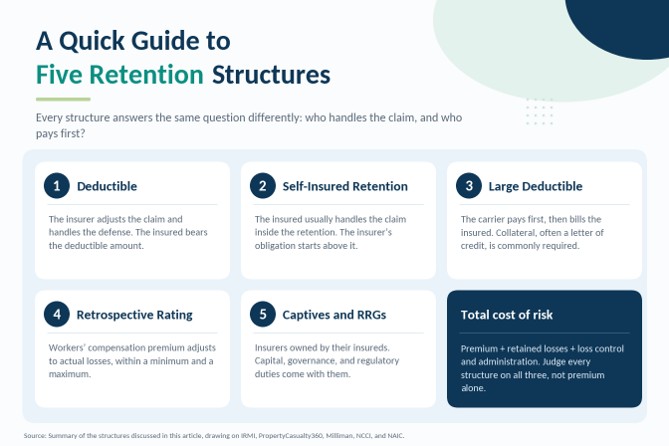
1. Deductibles
A deductible is the most familiar form of retention. A set amount of each covered loss is borne by the insured, and the insurer responds above it. According to a PropertyCasualty360 analysis of self-insured retentions, an insurer under a deductible generally holds responsibility for adjusting the claim, controlling settlement decisions, and handling the defense. Mechanics vary with the policy wording, but that makes deductibles a practical fit for businesses that want insurer-led claim handling and a predictable out-of-pocket amount. [6]
2. Self-Insured Retentions
An American Bar Association guide states plainly that “A self-insured retention is not the same as a deductible.” [7] The PropertyCasualty360 analysis notes that courts sometimes use the terms interchangeably, yet there are real differences. Within a self-insured retention, the insured usually carries the principal responsibility for handling the claim, and some retentions include both damages and legal costs. The insurer’s obligation begins above the retention. [6]
Policy wording governs every one of these points. Before accepting a self-insured retention, confirm who controls the defense, whether defense costs erode the retention, and how the retention is satisfied. Ask whether your business has the claims-handling capacity, or a third-party administrator, to manage claims inside the retention.
3. Large Deductible Programs
A large deductible program, as Milliman describes it, works differently from a conventional deductible. Milliman explains that the carrier is the first payer on all losses in these programs and then bills the insured for the amount that falls within the deductible. Terms vary by carrier and program. In its example, an insured with a $250,000 workers’ compensation deductible pays up to $250,000 on each claim, and the carrier takes what exceeds it. [8]
Because the carrier is exposed to the insured’s ability to reimburse it, Milliman reports that carriers will require collateral on large deductible programs. The preferred form is a letter of credit, though cash, a trust, or bonds can also be used. [8] Risk Management magazine adds that workers’ compensation claims are long-tail, often paid out over seven to 10 years. [9] For a business, that means the cash obligation can outlast the policy year by a wide margin, and collateral can tie up borrowing capacity.
4. Retrospective Rating
In workers’ compensation, a retrospective rating plan adjusts the premium according to losses incurred during the policy period. Under the Massachusetts bureau’s rules, for example, the plan is optional, both the employer and the carrier must agree to it, and it gives the insured an incentive to control losses. Eligibility thresholds and details vary by state. [10] An NCCI filing memorandum on retrospective rating parameters explains that the final premium is subject to minimum and maximum amounts and is not known until the policy has expired and the actual losses are fully developed. Favorable loss experience can reduce the premium and unfavorable experience can raise it, up to the maximum. That circular dates from 2005, so read it as a description of how the plan works, not as current rates. [11] New York’s retrospective rating manual, as another example, states that the premium will not be less than the selected minimum or more than the selected maximum. [16]
5. Captives and Risk Retention Groups
A captive is an insurance company created to insure the exposures of its owners. A Captive.com report on Business Insurance’s 2024 Captive Domicile Rankings counted 6,290 licensed captives worldwide, excluding micro-captives, series captives, and cells in protected cell companies. [12] The Vermont Department of Economic Development reported that Vermont licensed 51 new captives in 2025, bringing its active total to 707. [13]
Shared structures exist for businesses that do not want to capitalize an insurer on their own. The NAIC describes risk retention groups as liability insurance companies owned by their members and formed under the federal Liability Risk Retention Act of 1986. [14] Sponsored captives, which use protected cells, are another route that Reinsurance News describes as a licensed insurance vehicle with a proven framework for managing a business’s own risks. [15] Any captive brings capital, governance, and regulatory obligations that a deductible does not, so it warrants an actuarial feasibility study before commitment.
Retained Losses Are Funded Losses
Every retention is a promise to pay. The insurer’s price may fall when you retain more, but the obligation does not disappear. It moves to your cash, your reserves, or your credit line. That is why the central question is financial capacity, and the premium discount is secondary.
Test a proposed retention against a realistic bad year, not an average one. Consider how many claims inside the retention could land together, how quickly they would need payment, and what the business would delay or borrow to cover them. A guide on extra expense costs businesses should plan for after a loss explains that a covered loss can create costs beyond property damage, which matters when you decide how much operational disruption you can absorb.
Contracts add another layer. Landlords, lenders, and customers often specify minimum coverage terms, which can push a business toward more transfer than its finances alone would suggest. Read those requirements before you raise a retention, because a structure that works financially can still fail a contract.
A specific observation from the broker’s seat: a recent guide on how risk tolerance influences business insurance makes the point that your real cash cushion, and not the number on a quote, should guide the choice of deductible. It lists three warning signs that a program is out of sync with a company’s tolerance:
- Cash flow strain every time a deductible hits.
- Repairs delayed to avoid out-of-pocket costs.
- Very low deductibles purchased even though reserves could absorb routine losses.
The first two suggest a retention that is too high. The third suggests one that is too low.
Loss Control Makes Retention Affordable
Retained losses and loss control are linked. The more claims a business prevents, the more risk it can safely keep, and the less its retention costs over time. The risk tolerance guide cited above notes that prevention and retention work best together.
Underwriters are also looking for this. Marsh’s Q2 2026 release described capacity for U.S.-exposed risks as increasingly selective, with a strong focus on risk quality and program structure. [2] A business that proposes a higher retention while offering written procedures, training records, and a clean trend gives the carrier a reason to agree. Documentation matters as much as the controls themselves, because an underwriter can only credit what the file shows. Keep dated records of training, inspections, and corrective actions, and update them as operations change.
Several practical resources can help you build that file:
- How to strengthen loss prevention before it impacts claims or coverage covers early prevention and approaching coverage decisions with a stronger claims history.
- 5 ways businesses can strengthen risk controls looks at safeguards that reduce exposure and prepare a business for unexpected losses.
- How to reduce the financial impact of rising claim severity discusses evaluating claims trends, coverage structure, and loss exposure as costs rise.
- How insurance benchmarking can improve your coverage decisions shows how comparing insurance costs and coverage can strengthen your risk strategy.
If your retained losses include minor workplace injuries, the loss control solutions page describes a nurse hotline staffed by registered nurses around the clock, intended to reduce first aid claims and the medical costs tied to minor injuries, along with OSHA 300 tracking through MyWave.
A Simple Framework: Measure, Layer, Fund, Monitor
This working framework, which is not an industry standard, turns the retention decision into a repeatable process. Follow this sequence:
- Collect several years of loss runs and current exposure data. Calculate your total cost of risk: premium, retained losses, and the cost of loss control and administration. Separate frequency problems from severity problems, because they call for different fixes.
- Map each line of coverage into layers. Decide what the business retains, what it transfers, and where an excess or umbrella policy sits above the primary layer. Ask your broker to price more than one retention level for each line so that you can see what each additional dollar of retention saves. Where excess casualty pricing is rising, also review whether the attachment point of any umbrella or excess policy still fits the primary retention beneath it, since the layers interact.
- Decide how retained losses will be paid: operating cash, a dedicated reserve, a credit line, or collateral under a large deductible plan. Stress-test the decision against a bad year and against contract requirements.
- Review the structure at every renewal and after growth milestones. As the risk tolerance guide advises, reassess after major changes such as fast growth, a new location, or new contract demands. Track whether retained losses are running above or below what you expected and adjust the following year.
Practical Checklist Before Renewal
Use this list to prepare for a retention conversation with your broker.
- Gather current loss runs for every line and confirm claim status, dates, and amounts.
- Separate frequent small claims from large losses and note the cause of each large loss.
- Calculate total cost of risk, including premium, retained losses, and loss control spending.
- List cash reserves, credit availability, and obligations that compete for the same cash.
- Ask for quotes at several retention levels on each line, not only the current one.
- Confirm whether each proposal is a deductible or a self-insured retention, and who controls the defense.
- Check whether defense costs erode the retention.
- For any large deductible plan, ask how much collateral is required, what form it takes, and how it will be adjusted over time.
- Review lease, lender, and customer contracts for required limits and maximum retentions.
- Document safety procedures, training records, and corrective actions so that underwriters can see them.
- Estimate how a bad year, with several claims inside the retention, would affect cash flow.
- Assign an owner for the process and schedule a review after each growth milestone.
Common Missteps to Avoid
Even well-run companies repeat a few errors:
- Choosing a deductible for the biggest discount. The risk tolerance guide cautions that many businesses pick deductibles because they lower premium the most. Capacity should come first.
- Treating an SIR like a deductible. The two can differ on claim handling, defense costs, and timing, so wording matters.
- Overlooking collateral. A large deductible can solve a premium problem and create a liquidity problem.
- Ignoring contract requirements. A retention higher than a lease or loan allows can create a default risk of its own.
- Setting it and forgetting it. Retentions that fit a business of 20 employees may not suit one of 60.
How Infinity Insurance Partners Can Help You Build a Program That Fits
Choosing a retention takes judgment as well as data, and a broker adds value at that point. Infinity Insurance Partners is an insurance brokerage with offices in Scottsdale, Arizona and Albuquerque, New Mexico. Its property and casualty services include exposure analysis, retention analysis, claims analysis, loss control techniques, OSHA compliance and reporting, safety education and training, and the development of safety policies and programs.
The risk management page describes the Risk Insights publication, the services page outlines the full range of support, and the blog offers more guidance on loss prevention, claims, and coverage decisions.
Before a retention conversation, be ready to share:
- Several years of loss runs and current exposure data for every line.
- Your cash reserves, credit availability, and competing obligations.
- The coverage and maximum retention terms in your lease, lender, and customer contracts.
- Your written safety procedures, training records, and corrective actions.
- How you expect to pay for retained losses in a bad year.
Ready to review your retention strategy? Contact Infinity Insurance Partners to start the conversation about deductibles, retentions, and program structure ahead of your next renewal.
Final Takeaway
Good risk financing starts with a deliberate answer to one question: which losses will the business pay for itself, and which will it transfer? The 2026 market gives buyers more room to ask it, with property, cyber, and financial lines softening, but casualty pricing is still rising and capacity above the primary layer is getting more selective. A lower premium is only part of the picture.
Measure your total cost of risk, layer the program, fund the retained portion, and monitor it at every renewal. The best structure is not the one with the biggest discount. It is the one your cash, your documented loss control, and your contracts can support in a bad year. Infinity Insurance Partners recommends testing every retention level against that standard before you commit.
Frequently Asked Questions
What is risk financing?
Risk financing is the set of techniques a business uses to pay for losses by retaining them, transferring them, or combining both. Deductibles, self-insured retentions, large deductible plans, retrospective rating, and captives are all risk financing structures.
What is the difference between a deductible and a self-insured retention?
Under many deductible policies, the insurer generally adjusts the claim and handles the defense, and the insured bears the deductible amount. Under a self-insured retention, the insured usually has principal responsibility for handling the claim inside the retention, and the insurer’s obligation begins above it. Policy wording controls the details, so review it before you choose.
Does a higher retention always lower insurance costs?
Not necessarily. A higher retention can reduce premium, but the business pays more of each loss. If losses run high, retained costs can exceed the premium savings. Judge the decision on total cost of risk and test it against a bad year.
Why do carriers ask for collateral on large deductible programs?
Because the carrier pays claims first and then bills the insured, it is exposed to the insured’s ability to reimburse it. Milliman reports that carriers require collateral for this reason, most often a letter of credit, though cash, trusts, or bonds can also serve.
Is a captive an option for every business?
Captives take several forms, including single-owner captives, sponsored captives that use protected cells, and member-owned risk retention groups that write liability coverage. Each carries capital, governance, and regulatory obligations, so a feasibility review with an actuary and your broker should come before any decision.
If rates are falling, should we retain more?
Not automatically. Marsh reported in its Q3 2026 release that lower deductibles were achievable for clients renewing policies, so a soft market may give you more choice, in either direction. The decision still rests on your financial capacity, your loss experience, and your contract requirements.
How often should we revisit retention levels?
At least at every renewal, and again after major changes such as fast growth, a new location, or new contract demands. Review how retained losses performed against expectations and adjust the structure as needed.
Research and Further Reading
- [1] Marsh — Global commercial insurance rates fall 5% in Q3 2026; marks ninth consecutive quarterly decline (press release, October 21, 2026).
- [2] Marsh — Global commercial insurance rates fall 6% in Q2 2026; marks eighth consecutive quarterly decline (press release, July 23, 2026).
- [3] Business Insurance — Marsh targets more cost cuts; reports revenue increase (October 2026).
- [4] Insurance Journal — An Unsustainable Trend: Declining P/C Rates and Rising Cost of Risk (October 17, 2025).
- [5] IRMI — Planned retention (insurance definitions).
- [6] PropertyCasualty360 — Self-Insured Retentions: An Examination of the Uses and Problems (2013).
- [7] American Bar Association — The ABCs of Self-Insured Retentions and Deductibles.
- [8] Milliman — Large deductible programs: Demystifying collateral.
- [9] Risk Management magazine — How to Avoid “Collateral Damage” With Large Deductible Programs (2017).
- [10] Workers’ Compensation Rating and Inspection Bureau of Massachusetts — Retrospective Rating Plan.
- [11] NCCI — Item R-1395, 2005 Update to Retrospective Rating Plan Parameters (filing memorandum as posted by the North Carolina Rate Bureau, August 26, 2005).
- [12] Captive.com — Global Captive Market Grows as US, Offshore Domiciles Compete (Business Insurance 2024 Captive Domicile Rankings).
- [13] Vermont Department of Economic Development — 2025 captive licensing results (707 active captives, 51 new).
- [14] NAIC — Risk Retention Groups.
- [15] Reinsurance News — Vermont’s captive insurance industry sets new records (sponsored captives and protected cells).
- [16] New York Compensation Insurance Rating Board — Retrospective Rating Plan Manual.
Latest Posts

Commercial Dispute Funding: Key Considerations for Business Owners
Learn about commercial litigation funding, its financial implications, and important considerations for businesses navigating legal disputes.

How Property Damage Exposes Businesses to Financial Loss
Explore how property valuations, coverage limitations, and business interruption can affect a company’s financial resilience after a major loss.

Negligence and Its Impact on Commercial Liability
Learn how negligence claims arise, how commercial liability insurance responds, and how to align limits with real exposure before renewal.