
Blog

How to Evaluate Agentic AI Without Overlooking Emerging Liability Exposures
Software that can plan a task, make a decision, and act on it without waiting for a person is moving from pilot projects into daily operations. AI agents can answer customers, screen job applicants, process orders, write code, and move data between systems. Each of those actions can create a promise, a record, or a decision that someone outside the business relies on. When the output is wrong, the business that deployed the tool, not the tool itself, may be the one answering the claim, as the tribunal decision discussed below shows.
When you evaluate a new technology, look beyond cost, accuracy, and speed, and ask a question that matters just as much to the balance sheet: if this system causes a loss, which policy responds, and is that coverage still in the policy at renewal? Insurers have begun rewriting their answer. New standard exclusions, carrier-specific endorsements, and dedicated AI liability products have all appeared since 2025. This guide explains how to evaluate agentic AI through a liability and insurance lens, using published research, case law, and policy form language. Policy wording varies by carrier and edition, so confirm anything cited here against your own policy.
Key Takeaways
- The deploying business owns the output. A Canadian tribunal rejected an airline’s argument that its website chatbot was responsible for its own actions and ordered the airline to pay damages.[1]
- Standard liability coverage is changing. Verisk’s ISO forms now include optional generative AI exclusions for commercial general liability and products-completed operations coverage, with a January 2026 edition date.[2]
- Management liability is affected too. One carrier has introduced an “absolute” AI exclusion for D&O, E&O, and fiduciary liability policies.[3]
- Governance supports insurability. Documented oversight, human review, and vendor controls can help a business manage AI risk and explain that risk to an underwriter.
Why AI Agents Create a Different Kind of Liability Exposure
AI agents differ from traditional rules-based software. They interpret instructions, choose a sequence of steps, and act across connected systems, sometimes without a person reviewing each step. That autonomy is the source of their value and the source of a new class of risk, because the business may not know exactly what the system decided until after a customer, employee, or vendor has relied on it.
Adoption is expected to grow. Gartner predicts that at least 15% of day-to-day work decisions will be made autonomously by AI agents by 2028, up from 0% in 2024, and that 33% of enterprise software applications will include agentic AI by 2028, up from less than 1% in 2024.[4] Every one of those decisions is a potential point of liability.
Gartner also issued a caution. It predicts that over 40% of AI agent projects will be canceled by the end of 2027 because of escalating costs, unclear business value, or inadequate risk controls. It describes a trend it calls “agent washing,” in which vendors rebrand existing products, such as AI assistants, robotic process automation, and chatbots, without substantial agent capabilities; and it estimates that only about 130 of the thousands of vendors marketing these products are real.[4] For a buyer, that means the evaluation must test the vendor’s claims as carefully as the technology.
Investment levels vary widely. In a January 2025 Gartner poll of 3,412 webinar attendees, 19% said their organization had made significant investments in this technology, 42% had made conservative investments, 8% had made none, and the remaining 31% were taking a wait-and-see approach or were unsure.[4] Businesses at every one of those stages face the same question: what happens to liability and coverage as autonomy increases?
What the Data Shows About Adoption
McKinsey’s 2026 State of AI survey, based on 1,719 participants in 97 nations, found that 40% of respondents from organizations with annual revenues of more than $1 billion report scaling AI agents in one or more functions, up from 27% the year before. The share of respondents from smaller organizations reporting scaling remained flat at 22%.[5]
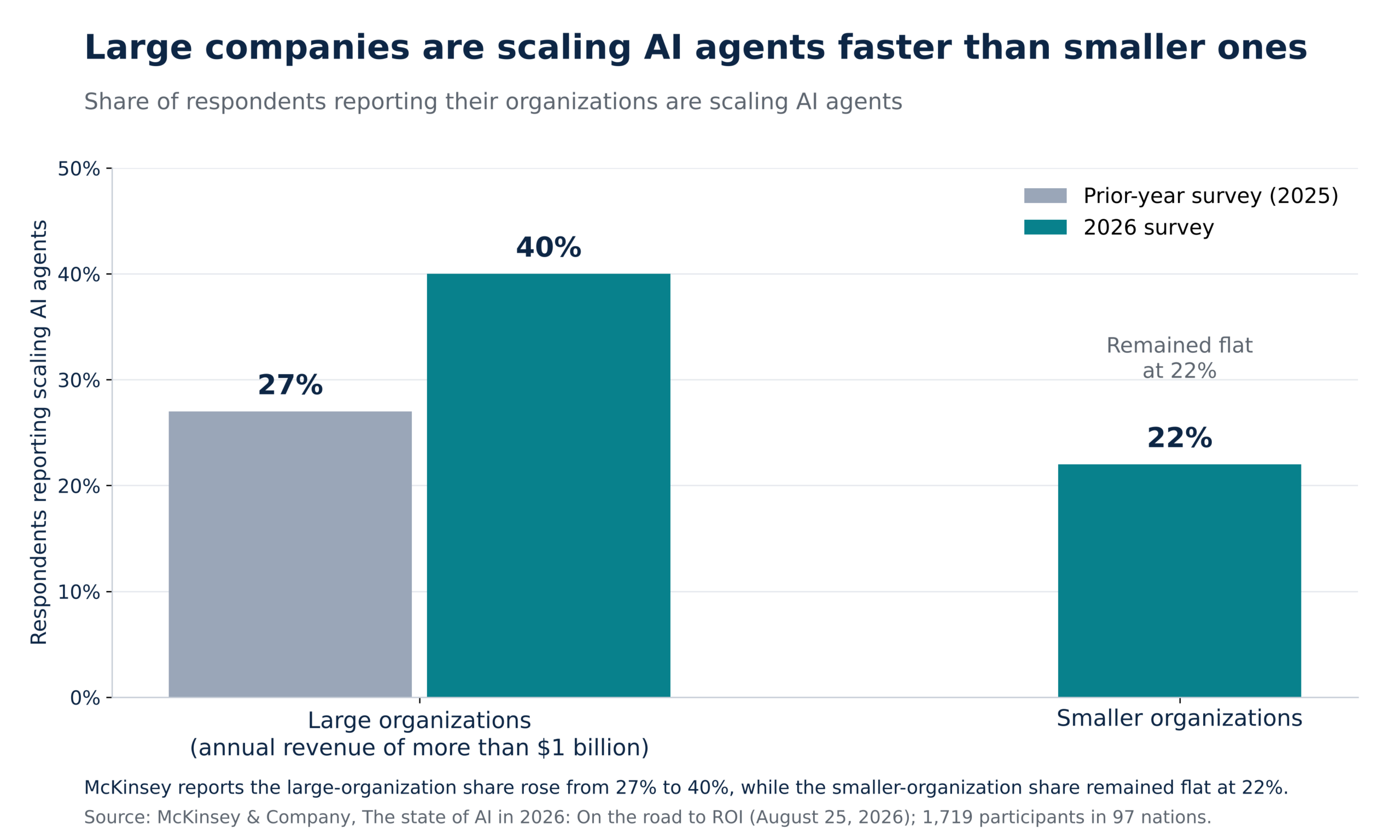
Figure 1. Share of respondents reporting their organizations are scaling AI agents, by company size. Source: McKinsey & Company, The state of AI in 2026: On the road to ROI (August 25, 2026).
The gap matters for growing companies. A business that has not yet scaled agents internally may still be exposed through the software it buys, because Gartner expects a growing share of enterprise software applications to include these capabilities.[4] McKinsey also found that AI high performers are much more likely than other respondents to report working to mitigate the exploitation of AI-driven technical vulnerabilities and unauthorized or unintended actions.[5] Those scenarios are worth discussing with your broker before an underwriter asks about them.
Who Is Liable When an AI Agent Gets It Wrong
An instructive example comes from British Columbia’s Civil Resolution Tribunal in Moffatt v. Air Canada, decided February 14, 2024. A customer used the airline’s website chatbot while researching bereavement fares, relied on its explanation of how to apply for a reduced fare, and was later refused. Air Canada argued, in effect, that the chatbot was a separate legal entity responsible for its own actions. The tribunal called that “a remarkable submission” and found that the airline was responsible for all the information on its website. It found negligent misrepresentation and ordered Air Canada to pay a total of $812.02 (Canadian dollars): $650.88 in damages, $36.14 in pre-judgment interest, and $125 in Civil Resolution Tribunal fees.[1]
The dollar amount was small. The principle is not. The decision indicates that a business that places an automated system between itself and its customers can be held accountable for what that system says. Because negligence turns on whether reasonable care was used, the guide on negligence and its impact on commercial liability is useful background for any team deploying customer-facing AI.
Liability can also reach the vendor. In Mobley v. Workday, a job applicant alleged that Workday’s AI-based applicant screening tools discriminated against job seekers. He did not allege that Workday itself was an employer; instead, he alleged that it could be held liable as an “agent” of the employers that used its tools. In July 2024, the U.S. District Court for the Northern District of California denied Workday’s second motion to dismiss, and on May 16, 2025, it granted conditional certification of the claims under the Age Discrimination in Employment Act (ADEA).[6] Neither ruling decided whether Workday is liable, but the case shows how claims involving automated decisions can extend to both the deploying business and its technology provider.
Five Liability Exposures to Evaluate Before Deployment
A useful evaluation sorts AI agent risk into exposures that map to specific policy lines. The categories below are a working framework, not an industry standard.
- Third-party bodily injury, property damage, and personal and advertising injury. An agent that drafts marketing content, publishes product information, or issues operating instructions can contribute to claims that historically fell under commercial general liability.
- Professional errors and misrepresentation. When an agent gives advice, quotes terms, or performs a service for a client, a mistake can give rise to a professional liability, or errors and omissions (E&O), claim. The Moffatt decision shows how a single automated answer can support a negligent misrepresentation claim.[1]
- Employment practices. Agents that screen, rank, or schedule workers can generate discrimination claims, as the Workday litigation illustrates.[6] Employment claims carry their own defense costs, which the guide on why an employment lawsuit can break a business fast explores in more detail.
- Security, privacy, and unintended actions. An agent with access to systems and data can be manipulated or can act outside its intended scope. McKinsey identifies AI-driven technical vulnerabilities and unauthorized or unintended actions as risks that high performers work to mitigate.[5] The guide on privacy breach risks in modern operations covers related data-protection controls.
- Management liability. Statements to investors about AI capabilities, and board oversight of AI risk, can become directors and officers (D&O) liability issues, particularly as at least one carrier has introduced an AI exclusion for management liability products.[3]
How Insurers Are Responding to AI Risk
The insurance market is treating AI as an emerging exposure, and the response is moving in two directions at once: narrowing coverage in traditional policies while building dedicated products.
New ISO Generative AI Exclusions
Verisk’s ISO division developed optional endorsements that allow carriers to exclude generative AI exposures, with a January 2026 edition date. CG 40 47 excludes coverage under Coverage A and Coverage B of the commercial general liability coverage part for bodily injury, property damage, or personal and advertising injury arising out of generative artificial intelligence. CG 40 48 applies the exclusion to Coverage B, personal and advertising injury, only. CG 35 08 excludes bodily injury or property damage arising out of generative AI under the Products/Completed Operations Liability Coverage Part.[2] The forms define generative AI as a machine-based learning system or model trained on data with the ability to create content or responses, including text, images, audio, video, or code.[2] Whether an AI agent’s activity falls within that definition will depend on the facts and on the endorsement wording a carrier attaches.
Carrier-Specific Exclusions
Some carriers are going further. In November 2025, Insurance Business, citing a Financial Times report, said that AIG, Great American, and WR Berkley had submitted requests for regulatory approval to limit their liability for claims arising from artificial intelligence systems, including chatbots and other automated services.[7] Berkley has also introduced a so-called “absolute” AI exclusion for its D&O, E&O, and fiduciary liability products. The wording targets claims tied to any actual or alleged use, deployment, or development of artificial intelligence, and its listed examples include representations, warranties, promises, or agreements made by a chatbot or virtual customer service agent, as well as inadequate or deficient policies, practices, procedures, or training relating to artificial intelligence.[3] An exclusion written that broadly can reach operations that never appear on an application as “AI.”
Definitions matter as much as the exclusions themselves. The ISO forms address generative AI specifically, while an exclusion that applies to any use of artificial intelligence can reach much further. Two policies that both mention AI can therefore respond very differently to the same claim, which is why the definitions section deserves a line-by-line review at renewal.
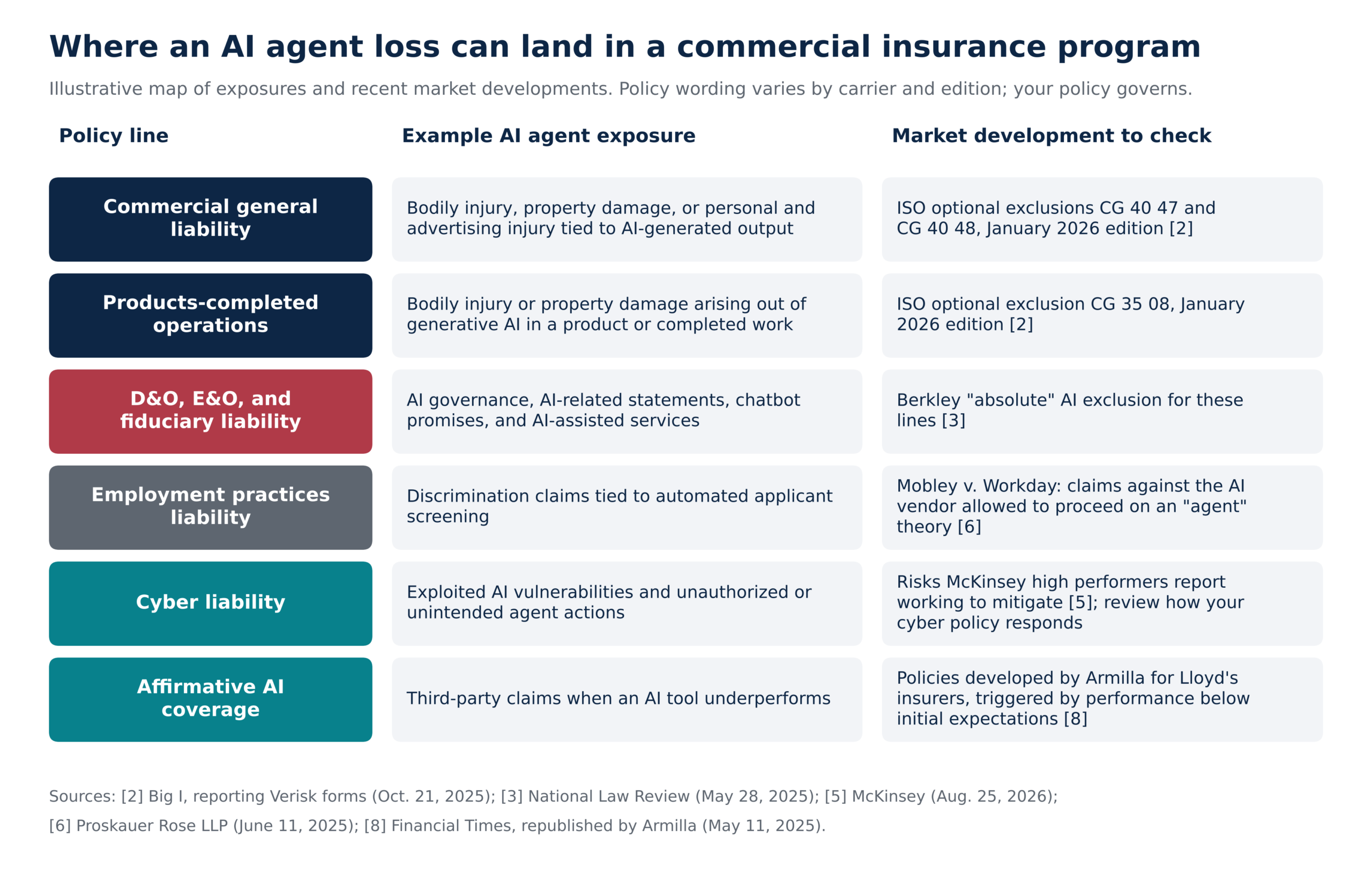
Figure 2. Where an AI agent loss can land in a commercial insurance program. Illustrative. Sources: Big I, reporting Verisk forms (2025); The National Law Review (2025); McKinsey & Company (2026); Proskauer Rose LLP (2025); Financial Times, republished by Armilla (2025).
Affirmative AI Coverage
New products are filling part of the gap. In May 2025, the Financial Times reported that insurers at Lloyd’s of London had launched a product to cover companies for losses caused by malfunctioning AI tools. The policies, developed by Armilla, a start-up backed by Y Combinator, cover costs such as damages and legal fees when a customer or another third party sues over harm caused by an underperforming AI tool. Chaucer is among the Lloyd’s insurers underwriting the policies. A mistake alone does not trigger a payout; cover applies if the insurer judges that the AI performed below initial expectations.[8] A Lockton broker quoted in the same report noted that a general policy covering up to $5 million in losses might carry a $25,000 sublimit for AI-related liabilities.[8] That example illustrates why sublimits deserve as much scrutiny as exclusions.
A Framework to Evaluate AI Agent Risk Before It Reaches Your Policy
The National Institute of Standards and Technology (NIST) released its AI Risk Management Framework 1.0 on January 26, 2023, as voluntary guidance for organizations that design, develop, deploy, or use AI systems. Its core is organized around four functions: govern, map, measure, and manage.[9] Those functions translate well into an insurance-focused review.
- Assign ownership of each AI agent, set approval thresholds, and document when a person must review an agent’s output before it reaches a customer, employee, or counterparty.
- Inventory every agent and every vendor product with agent features, the data and systems each one can access, and the decisions it can make without review. The guide on third-party technology risks businesses should watch explains why vendor dependencies belong in that inventory.
- Test accuracy, bias, and failure modes before launch and on a schedule after it. Keep the results, because they show the care exercised if a claim is ever made.
- Set response plans for errors, including how to pause an agent, correct statements made to customers, and notify the carrier. Then compare the exposure map with the insurance program. The guide on how risk assessment reveals insurance gaps before they become costly shows how this kind of review can surface coverage gaps before renewal.
Following the framework’s structure gives a business a consistent way to describe its AI controls to carriers, auditors, customers, and business partners.
Vendor Contracts and Risk Transfer
Contracts can determine who pays before an insurance policy responds. Before signing an AI vendor agreement, check whether it caps the provider’s liability, disclaims responsibility for outputs, or shifts compliance duties to your business. Review indemnity language, limitation of liability clauses, data-use rights, and insurance requirements before signing. The guide on contract red flags that signal when to walk away covers lopsided indemnity terms and uncapped liability, and the guide on compliance risk strategies for complex business exposures explains how to connect contract review, controls, and coverage.
Questions to Ask an AI Vendor Before You Sign
- What decisions can the agent make or execute without human approval, and can those permissions be limited?
- How is the system tested for accuracy and bias, and will you share the results?
- What logs are kept of the agent’s actions, and how long are they retained?
- Does the contract include an indemnity for claims caused by the product, and how is the vendor’s liability capped?
- What insurance does the vendor carry, and will it name your business as an additional insured where appropriate?
The answers shape the risk your business retains. A vendor that cannot explain how its product reaches decisions, or that will not share testing results, leaves the deploying business with less evidence of reasonable care if a claim is ever filed.
Pre-Renewal AI Liability Checklist
- List every AI agent in use, including agent features inside purchased software, and the decisions each can make without human review.
- Ask whether any generative AI exclusion, such as CG 40 47, CG 40 48, or CG 35 08, is attached to your general liability or products-completed operations coverage.
- Review D&O, E&O, fiduciary, and employment practices liability policies for AI exclusions, and read their definitions of artificial intelligence.
- Confirm how your cyber policy treats unauthorized or unintended actions by automated systems.
- Identify any AI-related sublimits and compare them with a realistic loss scenario.
- Ask whether affirmative AI coverage is available and what triggers it.
- Check vendor contracts for indemnity, liability caps, and required insurance.
- Keep records of testing, human review, and incident response for underwriting submissions.
Common Missteps to Avoid
- Treating AI as an IT decision only. Liability, contracts, and insurance belong in the evaluation from the start.
- Assuming last year’s policy still applies. New endorsements can change coverage at renewal without any change in operations.
- Relying on the vendor to absorb losses. Liability caps and disclaimers can leave the deploying business with most of the exposure.
- Ignoring sublimits. A policy can address AI and still cap that coverage at a small fraction of the overall limit, as the example of a $25,000 sublimit within a $5 million policy shows.[8]
- Skipping documentation. Without records of testing and oversight, it is harder to show reasonable care or to answer underwriting questions.
How a Broker Can Help You Close AI Liability Gaps
AI exposures can cross several policy lines at once, and, as the exclusions above show, the wording that controls them is changing. Infinity Insurance Partners is an insurance brokerage with offices in Arizona and New Mexico. Its property and casualty services include exposure analysis, retention analysis, claims analysis, loss control techniques, OSHA compliance and reporting, safety education and training, and developing safety policies and programs.
The property and casualty services page outlines that scope, the risk management page covers services such as near-miss and incident root cause analysis with follow-up reporting, and the loss control solutions page describes programs designed to reduce claims and costs. The blog offers more guidance on liability, contracts, and coverage decisions.
Before a coverage review, be ready to share:
- An inventory of AI tools and agents, the vendors behind them, and the decisions they make.
- Your current declarations and endorsements for general liability, products-completed operations, cyber, D&O, E&O, and employment practices liability.
- Key vendor contracts and any documentation of AI testing, oversight, and incident response.
Ready to test your coverage? Contact Infinity Insurance Partners to start a conversation about AI liability, policy exclusions, and coverage options ahead of your next renewal.
Frequently Asked Questions
What is the difference between an AI agent and a chatbot?
A basic chatbot responds to questions. An AI agent can also plan steps and take actions, such as updating records, placing orders, or sending messages, often across several connected systems. That ability to act can widen the liability exposure, because an error can become a completed transaction rather than only an inaccurate answer.
Is a business liable for mistakes made by its AI chatbot or agent?
It can be. In Moffatt v. Air Canada, the tribunal rejected the argument that the chatbot was a separate legal entity, held the airline responsible for information on its website, and awarded damages for negligent misrepresentation.[1]
Does commercial general liability insurance cover AI-related claims?
It depends on the policy. Verisk’s ISO forms include optional endorsements, CG 40 47 and CG 40 48, that allow carriers to exclude bodily injury, property damage, or personal and advertising injury arising out of generative AI, and CG 35 08 does the same for products-completed operations coverage.[2] Review your endorsement schedule at each renewal.
What is an absolute AI exclusion?
It is a broad exclusion that removes coverage for claims tied to any actual or alleged use, deployment, or development of artificial intelligence. Berkley has introduced one for its D&O, E&O, and fiduciary liability products.[3]
Is dedicated AI liability insurance available?
Yes, in some markets. In May 2025, the Financial Times reported that insurers at Lloyd’s of London had launched policies, developed by Armilla, that cover costs such as damages and legal fees when the insurer judges that an AI tool performed below initial expectations.[8] Terms, triggers, and limits vary.
How can a business reduce AI liability before buying insurance?
Assign ownership, inventory every agent and vendor, test performance and bias, require human review for high-impact decisions, and document each step. The NIST AI Risk Management Framework’s govern, map, measure, and manage functions offer a practical structure.[9]
Who should own AI liability risk inside a business?
One practical approach is shared ownership. Operations or IT owns the tool, legal or compliance reviews contracts and regulatory duties, and finance or risk management confirms that insurance limits, exclusions, and sublimits match the exposure. Naming a single accountable owner for each agent keeps those groups coordinated.
Research and Further Reading
[3] The National Law Review: The Continued Proliferation of AI Exclusions (May 28, 2025).
[5] McKinsey & Company: The state of AI in 2026: On the road to ROI (August 25, 2026).
Latest Posts

6 Trading Compliance Mistakes That Can Create Costly Business Exposures
Understand how regulatory obligations, internal controls, and operational oversight influence business risk, liability exposures, and insurance considerations.

How to Address Insolvency Risk Before It Disrupts Your Operations
Understand how financial instability among vendors, contractors, and business partners can affect your operations and create unexpected financial exposure.

How to Prepare for an Outage Without Disrupting Critical Operations
Learn how to reduce downtime, protect critical operations, and prepare for unexpected disruptions through proactive risk management.