
Blog

How to Address Insolvency Risk Before It Disrupts Your Operations
The best way to manage insolvency risk is to identify which vendors, contractors, and customers your operations cannot do without, test how each failure would hit your cash and your insurance, and put contract and coverage protections in place before any of them files. The need is current. Epiq AACER and the American Bankruptcy Institute reported 6,560 commercial Chapter 11 filings from January through September 2026, up 11% from 5,895 a year earlier, and Subchapter V elections rose 46%.[1] A failed partner can interrupt supply, strand a project, or leave an invoice unpaid, and the contingent business interruption coverage many buyers assume will help is typically triggered by physical damage, not by a supplier’s financial failure.[3]
Key Takeaways
- Vendor, contractor, and customer failures create financial exposure that a standard insurance program rarely addresses on its own.
- Epiq AACER reported commercial Chapter 11 filings up 11% and Subchapter V elections up 46% for January through September 2026, so counterparty failure is a live planning issue.[1]
- Marsh describes contingent business interruption as typically triggered by physical loss at a supplier or customer, and lists insolvency among the exclusions found in many policies.[3]
- A certificate of insurance is issued as a matter of information only. Confirm endorsements, limits, and policy status instead of relying on the certificate.[10]
- Trade credit insurance and surety bonds are built for customer non-payment and contractor default, two losses that property and liability policies do not target.[6,9]
- Bankruptcy law can suspend collection activity and allow a trustee to challenge payments received in the 90 days before a filing, so payment terms and records matter.[7,8]
- A repeatable process works best: map dependencies, stress-test cash, match each exposure to a transfer tool, and review at every renewal.
Introduction
Most commercial insurance programs are built around events that damage your own property, injure your own people, or create liability for your own operations. A vendor that runs out of cash, a subcontractor that abandons a half-finished job, or a key customer that stops paying fits none of those molds neatly. The loss is real and the premium is already paid, yet the policy may be silent. That gap is why the financial health of third parties belongs in the same conversation as property, liability, and business interruption coverage.
This guide explains how counterparty failure creates exposure, where the published data stands in late 2026, why coverage can fall short, and which insurance, surety, and contract tools respond to which problem. It closes with a working framework and a renewal checklist. Published figures are tied to their sources. The framework and checklist are working tools, not industry standards.
What the Research Suggests
- Filing trends: Epiq AACER and the American Bankruptcy Institute reported that Subchapter V elections for the first nine months of 2026 reached 2,442, up from 1,672 a year earlier.[1]
- Coverage triggers: Marsh says contingent business interruption typically responds when a key supplier or customer suffers direct physical loss.[3]
- Certificates: The ACORD 25 certificate states that it confers no rights upon the certificate holder.[10]
- Court process: The U.S. Courts describe an automatic stay that suspends judgments, collection activities, foreclosures, and repossessions once a debtor files.[7]
What Does Financial Instability Among Vendors, Contractors, and Partners Mean for Your Business?
Insolvency risk, in a commercial setting, is the chance that a party you depend on can no longer pay its debts or perform its contract. That party might be a sole-source supplier, a subcontractor, a logistics provider, or a customer that owes you money. Insolvency does not always end in liquidation. Chapter 11 of the Bankruptcy Code generally provides for reorganization, and the debtor typically keeps possession and control of its assets while it restructures.[7] The company can keep operating, yet its creditors’ collection rights are suspended and its contracts may be assumed or rejected under 11 U.S.C. § 365.[7]
For an insurance buyer, the useful question is not whether a counterparty will file. It is which of your losses would follow if it did. Those losses fall into four groups:
- Supply loss: a critical input stops arriving and your operations slow or halt.
- Performance loss: a contractor leaves work unfinished and you pay to complete it.
- Payment loss: a customer fails to pay receivables you have already booked.
- Protection loss: an indemnity or insurance obligation that was supposed to protect you proves worth less than expected because the party behind it cannot pay.
Each group connects to a different tool, which is why a single answer such as “buy more insurance” rarely fits.
What the Filing Data Shows in Late 2026
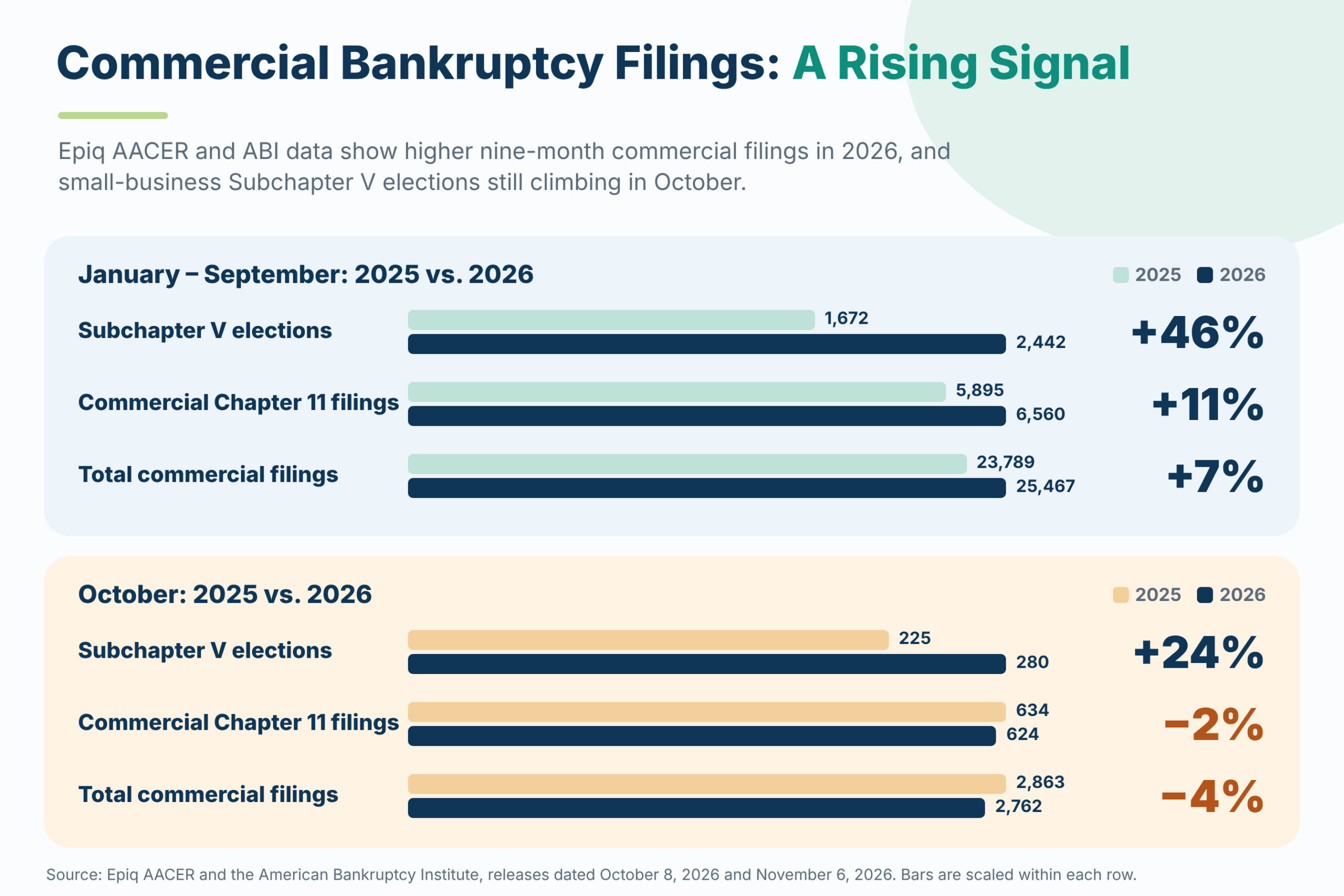
Bankruptcy filings are an imperfect proxy for counterparty distress, because many struggling companies never file. They do show the direction of travel. Epiq AACER’s release dated October 8, 2026 covered January 1 through September 30,[1] and its November 6, 2026 release covered October.[2]
| Measure | Period | 2025 | 2026 | Change |
| Commercial Chapter 11 filings | Jan–Sep | 5,895 | 6,560 | +11% |
| Total commercial filings | Jan–Sep | 23,789 | 25,467 | +7% |
| Subchapter V elections | Jan–Sep | 1,672 | 2,442 | +46% |
| Commercial Chapter 11 filings | October | 634 | 624 | −2% |
| Total commercial filings | October | 2,863 | 2,762 | −4% |
| Subchapter V elections | October | 225 | 280 |
+24% |
Source: Epiq AACER and the American Bankruptcy Institute, releases dated October 8, 2026[1] and November 6, 2026.[2]
Read the table as elevated but uneven. Nine-month commercial filings are higher, while October commercial Chapter 11 and total commercial filings dipped slightly from a year earlier and Subchapter V elections kept climbing. Michael Hunter, Vice President of Epiq AACER, said that “As cost pressures mount, more small businesses are turning to Subchapter V to reorganize.”[1] Because Subchapter V is a small-business restructuring option within Chapter 11, its increasing use is relevant to businesses assessing the financial stability of smaller suppliers, contractors, and other commercial partners.
Where Third-Party Failure Turns Into Financial Exposure
A counterparty’s trouble reaches your balance sheet through a handful of channels. Knowing which ones apply tells you which protection to look for.
1. Supply Continuity
When a hard-to-replace supplier stops shipping, your revenue pauses while payroll, rent, and debt service continue. A financial scenario planning guide lists a long supply chain failure among the rare but high-impact events worth modeling, and asks how long the business can run without revenue and which costs continue during a shutdown.
2. Contractor Performance
A subcontractor that abandons a half-finished job leaves you paying to finish it, often at a higher price and on a later schedule. Indemnity language in the contract shifts liability on paper, but its value depends on the contractor’s ability to pay. This guide to contractor liability risks recommends pairing indemnity language with verified insurance requirements rather than relying on it alone.
3. Customer Non-Payment
A customer that files for bankruptcy can leave you holding receivables you have already booked. Credit insurance coverage is designed for this loss. Allianz Trade describes it as protection from non-payment of commercial debt, with covered risks including insolvency and protracted default.[6]
4. Certificate and Contract Gaps
Many businesses collect a certificate of insurance and consider the matter closed. The ACORD 25 form says the certificate is issued as a matter of information only and confers no rights upon the certificate holder. It also says that if the holder is an additional insured, the policy must have additional insured provisions or be endorsed.[10] A certificate is a snapshot, not a guarantee that the policy is in force, endorsed, or adequate.
5. Insurer Financial Failure
The party that fails can also be an insurer. State property and casualty guaranty funds provide limited protection for eligible claims when a licensed insurer becomes insolvent. Coverage, exclusions, and payment limits vary by state.[11] Because payouts are capped, a policy backed by a financially weak carrier is not the same as a policy backed by a strong one.
Why Standard Coverage Often Falls Short
Business owners frequently assume that contingent business interruption, the coverage that responds to disruption at someone else’s location, will pick up a supplier’s financial failure. The published descriptions point the other way.
- The trigger is usually physical. Marsh says contingent business interruption typically responds when a key supplier or customer suffers direct physical loss, and typically to physical damage or disruptions affecting direct Tier 1 suppliers.[3]
- Insolvency can be excluded. Marsh lists exclusions for cyber incidents, labor strikes, pandemics, and insolvency as examples of limits found in many policies.[3]
- Scope can be narrow. Marsh notes sublimits, waiting periods, deductibles, and coverage limited to named or scheduled suppliers, which can leave unscheduled but essential suppliers uncovered.[3]
- Direct and indirect suppliers can differ. A Hunton analysis states that contingent time element and contingent extra expense coverage apply when the damaged property belongs to a supplier or customer, and that sublimits and deductibles may differ for direct and indirect suppliers.[4]
- Locations may need to be identified. IRMI frames the issue as whether the policyholder must identify the specific locations for which the coverage will be provided.[5]
A related post on third-party technology risks makes the same point about outside platforms: coverage may not extend automatically, so review policy language for contingent business interruption or dependent property provisions. Wording varies by carrier and form, so confirm the trigger, the named-supplier schedule, the supplier tiers, and the exclusions before you assume a policy will respond.
Matching Each Exposure to the Right Protection
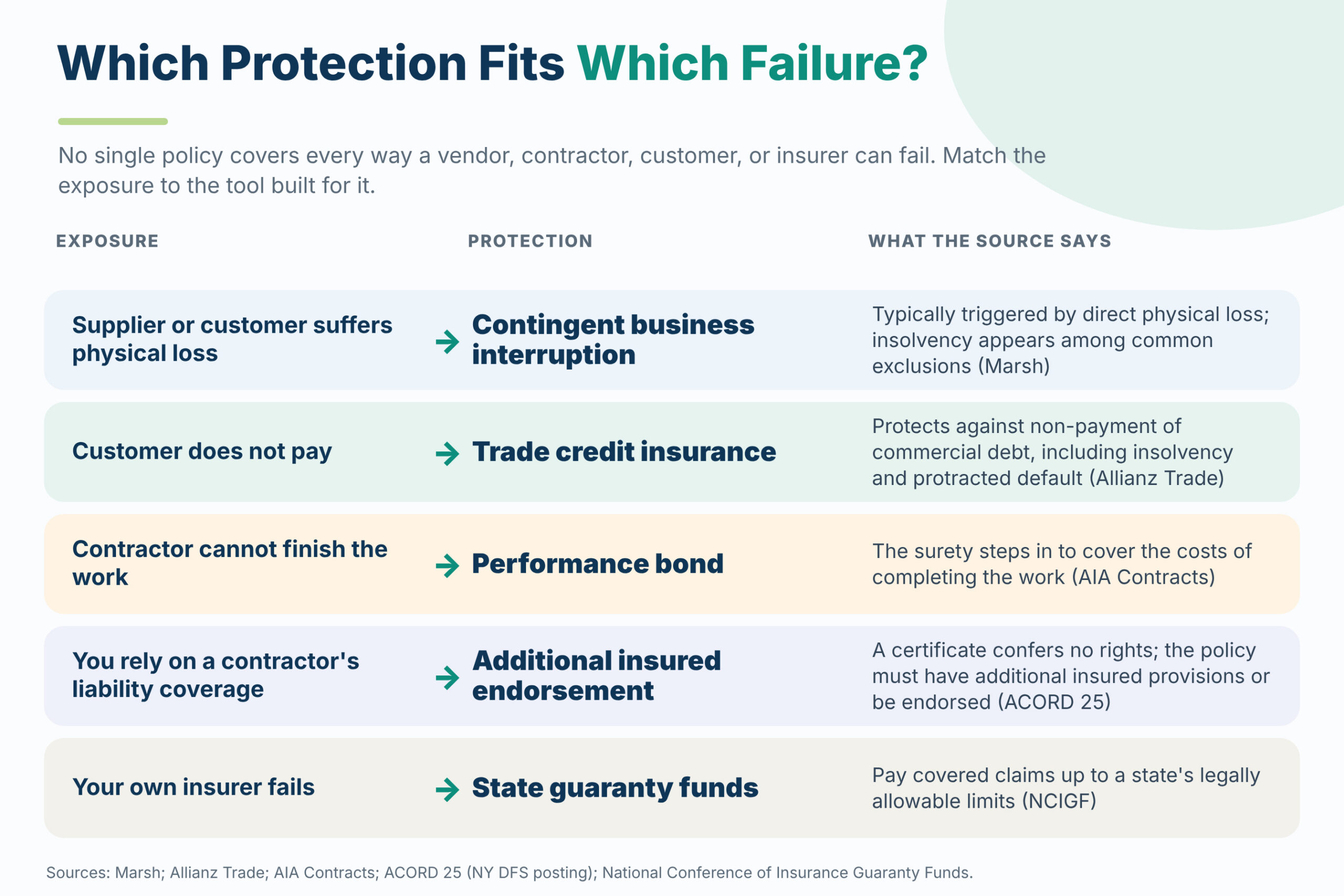
No single policy answers every form of counterparty failure. The table pairs each exposure with the tool designed for it, using what the cited sources say.
| Exposure | Protection | What the source says | Watch for |
| Supplier or customer suffers physical loss | Contingent business interruption | Typically responds when a key supplier or customer suffers direct physical loss[3] | Insolvency exclusions, sublimits, and named-supplier schedules[3] |
| Customer does not pay | Trade credit insurance | Protects against non-payment of commercial debt, including insolvency and protracted default[6] | Coverage depends on the insured receivable, approved buyer credit limits, and policy terms[6] |
| Contractor cannot finish the work | Performance bond | The surety may arrange for the work to be completed or provide financial compensation, depending on the bond terms and applicable limits[9] | Confirm the bond terms and the surety behind it |
| Contractor’s insurance is needed to protect you | Additional insured endorsement | The policy must have additional insured provisions or be endorsed[10] | A certificate alone confers no rights[10] |
| Your insurer fails | State guaranty funds | Pay covered claims up to a state’s legally allowable limits[11] | Payments are capped by state law[11] |
Two points deserve emphasis. First, a performance bond and an indemnity clause are different instruments. The bond adds a third party, the surety, whose obligation is to see the work completed.[9] An indemnity clause relies on the contractor’s own balance sheet. Second, each tool covers a defined loss. Trade credit insurance addresses unpaid invoices, not a stalled production line, and contingent business interruption addresses the stalled line only when the policy trigger is met.
What Bankruptcy Law Means When a Customer or Vendor Files
Once a counterparty files, court rules shape what you can do. This is general information, not legal advice, and counsel should review any specific situation.
- Collection pauses. The automatic stay generally suspends judgments, collection activities, foreclosures, and repossessions for debts that arose before the petition was filed.[7]
- The business may keep running. A debtor in possession keeps possession and control of its assets, generally continues operating, and may use or sell estate property in the ordinary course without prior court approval.[7]
- Contracts can be assumed or rejected. Disputes may arise over the assumption or rejection of executory contracts and unexpired leases under 11 U.S.C. § 365.[7]
- Earlier payments can be challenged. Under 11 U.S.C. § 547, a bankruptcy trustee may seek to recover certain preferential transfers made within 90 days before filing, or within one year before filing when the recipient was an insider. Specific statutory conditions must be met, and defenses such as the ordinary-course-of-business exception may apply.[8]
The practical lesson for a business is to keep clean records of payment history, contract terms, and any new value you provided, and to bring in counsel early. Insurance cannot undo these rules, so credit limits and payment terms are part of your protection.
Early Warning Signs and Due Diligence for Critical Vendors
Financial distress rarely announces itself. The indicators below are practical working observations, not predictors validated by the cited sources. Treat them as prompts to ask questions.
- Payment behavior changes. A vendor asks for prepayment, shorter terms, or a deposit it did not require before.
- Performance slips. Deliveries run late, quality drops, or the vendor stops answering routine requests promptly.
- Insurance lapses. A certificate expires, a policy is canceled or non-renewed, or limits fall below contract requirements.
- Public signals. Lawsuits, liens, or news coverage point to cash strain.
- One vendor or customer supplies or buys more than you could replace quickly.
Due diligence turns those prompts into controls. For critical vendors and larger subcontractors, consider the following:
- Verify insurance, not just certificates. Request the endorsements that grant additional insured status, check limits against the contract, and diary every renewal date. The commercial insurance terms and definitions guide explains certificates, additional insureds, endorsements, and exclusions in plain language.
- Write protections into the contract. Useful provisions include minimum insurance requirements, notice of material financial or insurance changes, access to records, and transition assistance. Have counsel review the language.
- Identify substitutes in advance. Qualify an alternate supplier or subcontractor before you need one, so a failure becomes a switch instead of a shutdown.
- Set credit limits for customers. Match exposure to each buyer’s payment record, and consider whether trade credit insurance fits your largest receivables.[6]
Document each check, the date it was done, and who owns the next review, so the process survives staff changes and can be repeated at every renewal.
A Simple Framework: Map, Stress-Test, Transfer, Monitor
This working framework, which is not an industry standard, turns third-party exposure into a repeatable process.
- List the vendors, subcontractors, and customers whose failure would stop revenue or create a large unpaid balance. A guide on economic volatility and strategic risk planning recommends mapping key dependencies and reviewing business interruption triggers.
- Stress-test. Model what happens to cash if each critical party fails for 30, 60, and 90 days. Include costs that continue during the outage. If retained losses are part of the answer, a risk financing guide explains why every retention is a promise to pay and should be tested against a realistic bad year.
- Match each exposure to a tool: contingent business interruption, trade credit insurance, performance bonds, additional insured endorsements, or tighter contract terms.
- Review the map at every renewal and after any major change, such as a new supplier, a new contract, or a customer that now represents a larger share of revenue.
Practical Checklist Before Your Next Renewal
- List your critical vendors, subcontractors, and top receivables by dollar value.
- Read the contingent business interruption wording for its trigger, exclusions, sublimits, and any named-supplier schedule.
- Confirm whether insolvency appears as an exclusion in any form.
- Collect endorsements, not only certificates, from contractors who work on your behalf.
- Calendar every contractor policy expiration date.
- Ask your broker whether trade credit insurance or surety bonds fit your largest exposures.
- Document payment histories and contract terms for key customers.
- Estimate cash flow under a 30-, 60-, and 90-day supplier failure.
- Assign one owner for the review and schedule it with the renewal calendar.
How Infinity Insurance Partners Can Help You Close the Gaps
Closing third-party gaps takes judgment as well as data, and a broker adds value by reading policy wording against your real dependencies. Infinity Insurance Partners is an insurance brokerage with offices in Scottsdale, Arizona and Albuquerque, New Mexico. Its property and casualty services include exposure analysis, retention analysis, claims analysis, loss control techniques, OSHA compliance and reporting, and safety education and training. That work helps you build the exposure and loss picture the framework above depends on. The risk management page describes job-site inspection, incident management, and process management support, the services page outlines the full range of help, and the blog offers more guidance on coverage and risk decisions.
Before a coverage conversation, be ready to share:
- Your list of critical vendors, subcontractors, and top customers by dollar exposure.
- Current business interruption wording, including any contingent or dependent property provisions.
- Contractor insurance requirements, endorsements, and certificate renewal dates.
- Payment terms and credit exposure for your largest customers.
- Your cash position and how long you could operate through a supplier failure.
Ready to review your exposure to vendor and customer failure? Contact our team to start a conversation about contingent coverage, contract protections, and your next renewal.
Frequently Asked Questions
Does contingent business interruption cover a supplier’s bankruptcy?
Not on its own, in most cases. Marsh says the coverage typically responds when a key supplier or customer suffers direct physical loss, and it lists insolvency among the exclusions found in many policies.[3] Wording varies, so have your broker read your form.
What does trade credit insurance cover?
Allianz Trade describes it as protection from non-payment of commercial debt, with covered risks including insolvency and protracted default.[6]
Does a certificate of insurance protect me if a contractor fails?
A certificate does not do so by itself. The ACORD 25 states that it is issued as a matter of information only and confers no rights upon the certificate holder.[10]
What does a performance bond do?
It is a guarantee that the contractor will carry out the work as the contract requires. If the contractor defaults, the surety may arrange for the work to be completed or provide financial compensation, depending on the bond terms and applicable limits.[9]
Can a customer’s bankruptcy affect payments I already received?
Potentially. Under 11 U.S.C. § 547(b), a trustee may avoid certain transfers made on or within 90 days before the filing, or up to one year for insiders, subject to defenses such as the ordinary course of business.[8] Ask counsel how this applies to your facts.
How often should we review third-party exposure?
At every renewal, and again after a major change such as a new critical supplier, a new contract, or a customer that now represents a larger share of revenue. This is a working practice, not a published standard.
Research and Further Reading
- [1] Epiq AACER and the American Bankruptcy Institute — Small Business Subchapter V Elections Increase 46% Compared to Last Year (press release, October 8, 2026).
- [2] Epiq AACER and the American Bankruptcy Institute — October Small Business Subchapter V Elections Increase 24% Year Over Year (GlobeNewswire, November 6, 2026).
- [3] Marsh — Contingent business interruption.
- [4] Hunton — Insurance Coverage for Supply Chain Interruptions.
- [5] IRMI — Contingent Business Interruption Coverage: Is Your Supply Chain Covered?
- [6] Allianz Trade — Guide to trade credit insurance: Definition, benefits & how it works.
- [7] U.S. Courts — Chapter 11 – Bankruptcy Basics.
- [8] U.S. House Office of the Law Revision Counsel — 11 U.S.C. § 547, Preferences.
- [9] AIA Contracts — What is a Performance Bond? Understanding Payment and Performance Bonds in Construction.
- [10] ACORD 25 Certificate of Liability Insurance form, as posted by the New York State Department of Financial Services.
- [11] National Conference of Insurance Guaranty Funds — What is a guaranty fund?
Latest Posts

6 Trading Compliance Mistakes That Can Create Costly Business Exposures
Understand how regulatory obligations, internal controls, and operational oversight influence business risk, liability exposures, and insurance considerations.

How to Evaluate Agentic AI Without Overlooking Emerging Liability Exposures
Explore how autonomous business technologies introduce new liability considerations, accountability challenges, and coverage questions for growing organizations.

How to Prepare for an Outage Without Disrupting Critical Operations
Learn how to reduce downtime, protect critical operations, and prepare for unexpected disruptions through proactive risk management.