
Blog
6 Trading Compliance Mistakes That Can Create Costly Business Exposures
The trading compliance mistakes that create the largest business exposures are rarely dramatic. They are routine gaps: a tariff code no one rechecked, a supplier’s country of origin taken on trust, a customer never screened against sanctions lists, or a customs bond sized for last year’s duties. Federal enforcement is aimed squarely at these gaps. In August 2025, the Department of Justice and the Department of Homeland Security launched a cross-agency Trade Fraud Task Force to pursue importers and others who evade tariffs and duties,[1] and the Justice Department reported more than $6.8 billion in False Claims Act settlements and judgments for fiscal year 2025, the highest single-year total in the statute’s history.[2] For business owners, the real question is not only whether a violation could happen, but how much of the resulting cost the insurance program would actually absorb.
Key Takeaways
- Regulatory risk tied to importing, exporting, and cross-border payments creates costs that property and liability policies were never designed to cover.
- Changes in legislation and regulation, a category that includes tariffs, ranked as the fourth-largest global business risk in the Allianz Risk Barometer 2026.[3]
- The importer of record carries the legal duty of reasonable care, even when a customs broker files the entry.[4]
- Customs penalties scale with culpability, from two times the lost duties for negligence up to the full domestic value of the merchandise for fraud.[5]
- Most D&O policies exclude fines, penalties, and multiplied damages, so internal controls do more to limit this exposure than insurance alone.[6]
- A customs bond guarantees payment to CBP, and sureties may ask importers for collateral, letters of credit, or indemnity support.[7]
Introduction
Most commercial insurance programs respond to accidents, injuries, and physical damage. Compliance failures produce a different kind of loss: back duties, civil penalties, investigation costs, delayed shipments, and in serious cases criminal exposure for the company and its leaders. Many of those costs are uninsurable, and the ones that may be covered depend heavily on policy wording. That makes trade rules a risk management issue, not just a logistics task handled by the shipping department.
The concern is widely shared. The Allianz Risk Barometer 2026 ranked changes in legislation and regulation fourth among global business risks, cited by 26% of respondents, and listed tariffs among the examples in that category.[3] This guide explains six common mistakes, the enforcement authority behind each one, and the insurance and contract considerations that follow. Published figures are tied to their sources. The checklist is a working tool, not a legal standard, and nothing here is legal advice.
What the Research Suggests
- Enforcement focus: The Justice Department says its customs matters target parties who misrepresent the type of goods imported or an item’s country of origin, or who hide merchandise to avoid paying duties.[2]
- Whistleblower activity: Whistleblowers filed 1,297 qui tam lawsuits in fiscal year 2025, the highest number in a single year, according to the Justice Department.[2]
- Settlement example: Ceratizit USA agreed to pay $54.4 million in December 2025 to resolve allegations involving country of origin, tariff classification, and marking duties. The claims are allegations only, with no determination of liability.[8]
- Tariff volatility: On February 20, 2026, the Supreme Court held that IEEPA does not authorize the President to impose tariffs. The ruling does not apply to tariffs imposed under other authorities, such as Sections 232 and 301.[9]
Why Trade Rules Create Business Exposure, Not Just Paperwork
Any business that imports components, exports finished goods, or buys from and sells to foreign parties is subject to customs, sanctions, and export control rules. That includes manufacturers sourcing parts overseas, distributors reselling imported products, and contractors buying imported materials. A compliance failure can create three layers of financial exposure at once.
- Duties owed: unpaid duties, taxes, and fees, plus interest, become a direct cost once an error is found.
- Civil penalties: customs, sanctions, and export authorities can assess penalties that may exceed the value of the underlying transaction.
- Litigation and investigation costs: False Claims Act suits, government subpoenas, and internal investigations require counsel, forensic accountants, and management time.
Insurance responds unevenly across those layers. Defense costs may be covered under a directors and officers (D&O) or management liability policy, depending on how the policy defines a claim. Fines and penalties are a different story, and that gap is why controls matter more than coverage. A related guide on 6 compliance risk strategies for complex business exposures recommends mapping each regulatory obligation to a specific control, contract term, and policy, then flagging the gaps.
The Six Mistakes and What Each One Can Cost
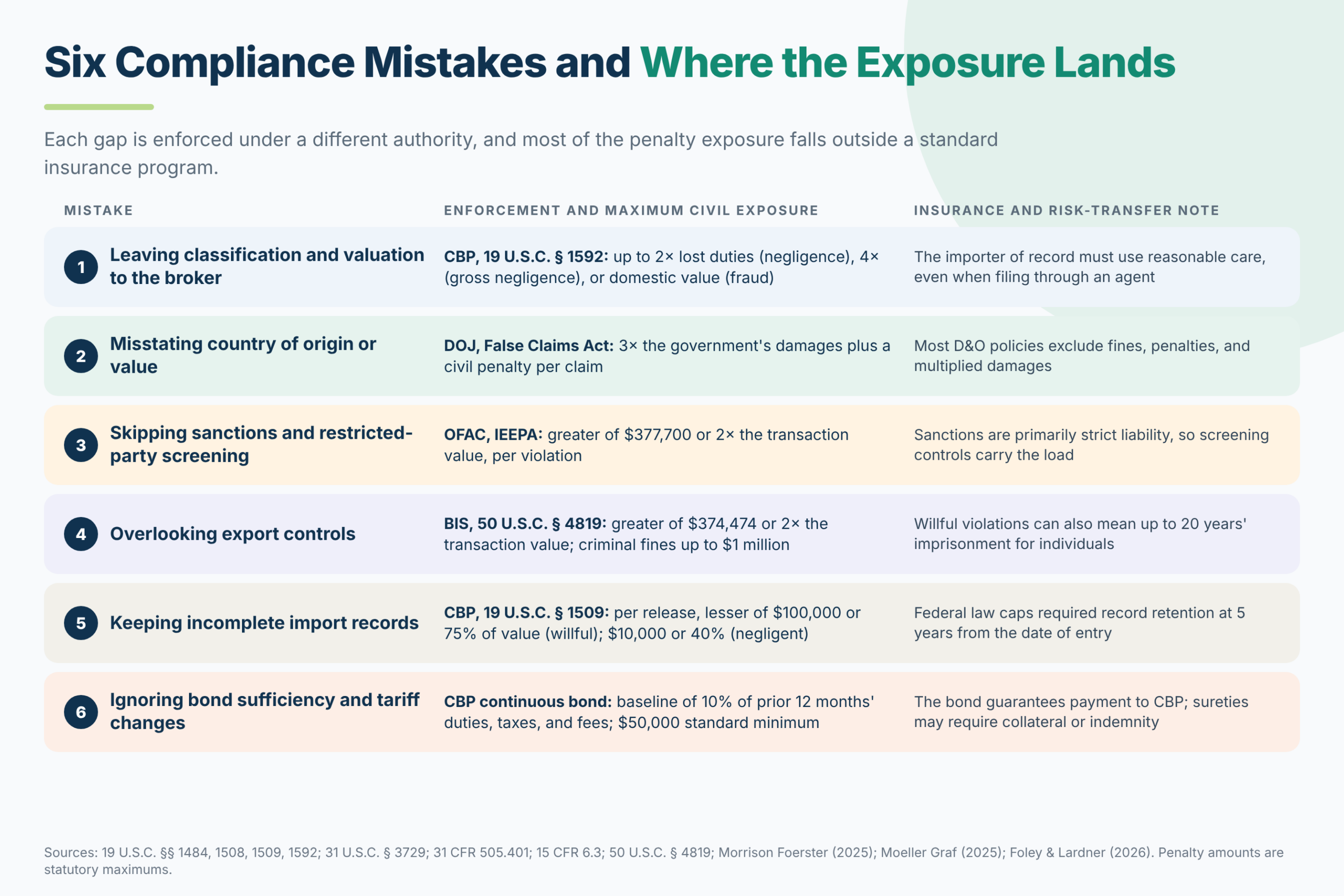
1. Treating Classification and Valuation as the Broker’s Problem
Section 484 of the Tariff Act requires the importer of record to use reasonable care when making entry, whether the importer files directly or through an authorized agent.[4] A licensed customs broker prepares the entry from the information the importer supplies. If the product description, tariff classification, value, or origin data is wrong, the importer still owns the result.
The penalty structure under 19 U.S.C. § 1592 is tied to culpability. A negligent violation can draw a penalty of up to the lesser of the domestic value of the merchandise or two times the lost duties, taxes, and fees. For gross negligence, the multiple rises to four times, and fraud can reach the full domestic value. When a violation did not affect the duties owed, the caps are 20% of dutiable value for negligence and 40% for gross negligence.[5]
Brokers and freight forwarders are vendors, and their service agreements may limit their liability. Before relying on a service provider, review the contract’s limitation clauses, indemnity language, and insurance requirements. The guide to managing vendor relationships to protect operational stability explains how to tier vendors by risk and verify their coverage.
2. Misstating Country of Origin or Value
Country of origin determines which tariffs apply, and declared value drives the duty calculation. The Justice Department has named the avoidance of tariffs and customs duties a key enforcement area, and its customs matters focus on parties that misrepresent the type of goods or their country of origin, or that hide merchandise to avoid paying duties.[2] The Ceratizit settlement, for example, involved allegations that Chinese-made tungsten carbide products were shipped through Taiwan and declared as Taiwanese in origin to avoid Section 301 tariffs. As the Justice Department notes, those claims remain allegations only.[8]
These cases often proceed under the False Claims Act, which imposes a civil penalty for each violation plus three times the government’s damages.[10] A court may reduce damages to no less than double when a company reports the violation to investigators within 30 days of learning of it, fully cooperates, and reports before any enforcement action has begun.[10] From an insurance standpoint, multiplied damages are a problem. Most D&O policies exclude fines, penalties, and multiplied damages from covered loss.[6] Supplier certifications of origin, audit rights, and indemnity clauses help, but an indemnity is only as strong as the supplier’s ability to pay.
3. Skipping Sanctions and Restricted-Party Screening
Sanctions rules apply to customers, suppliers, banks, freight agents, and anyone else on the other side of a transaction. U.S. sanctions are primarily a strict liability regime, and there are generally no knowledge or intent requirements before liability is triggered.[11] Under IEEPA, the maximum civil penalty is the greater of $377,700 or twice the amount of the transaction that is the basis of the violation.[12]
Screening is the first line of defense. The government’s Consolidated Screening List combines export screening lists from the Departments of Commerce, State, and the Treasury, although users are told to verify matches against the official lists before acting.[13] For a broader program, OFAC’s Framework for Compliance Commitments identifies five essential components: management commitment, risk assessment, internal controls, testing and auditing, and training.[14] Screening should happen at onboarding and again whenever ownership, destination, or end use changes.
4. Overlooking Export Controls on Products, Software, and Technology
Export controls can apply to physical goods, software, and technical data, and they can be triggered by the destination, the end user, or the end use. The penalty provisions are significant. Under the Export Control Reform Act of 2018, codified at 50 U.S.C. § 4819, the civil penalty is the greater of a statutory dollar amount or twice the value of the transaction,[15] and the inflation-adjusted dollar amount currently listed by the Department of Commerce is $374,474 per violation.[16] Willful violations can bring criminal fines of up to $1,000,000 and, for individuals, imprisonment of up to 20 years.[15]
Businesses expanding abroad face a second layer of issues, including whether existing policies respond outside the United States. The article on managing insurance risk during overseas expansion covers territorial limits, local licensing, and coverage structures, while the post on navigating political instability in global markets discusses political risk and trade credit insurance for foreign exposures.
5. Keeping Incomplete or Disorganized Import Records
Customs law requires importers to keep entry records. The statute caps the required retention period at five years from the date of entry, and the exact period is set by regulation.[17] Failing to produce demanded records carries its own penalties. For each release of merchandise, a willful failure can result in a penalty of up to the lesser of $100,000 or 75% of the appraised value, and a negligent failure up to the lesser of $10,000 or 40%.[18]
Good records do more than avoid recordkeeping penalties. They show that the company exercised reasonable care, support a prior disclosure if an error is found, and give underwriters evidence of a controlled operation. As the guide on ways businesses can strengthen risk controls points out, documented procedures keep operations consistent when staff change and help demonstrate reasonable care if a dispute arises.
6. Ignoring Customs Bond Sufficiency and Tariff Changes
A customs bond is a financial guarantee to CBP that duties and other obligations will be paid, including taxes, fees, and penalties.[7] The baseline amount for a continuous bond is typically 10% of the duties, taxes, and fees paid or payable over the preceding twelve months, and the standard minimum is $50,000.[7] CBP reviews sufficiency on a rolling basis and may require an increase before the bond’s anniversary date.[7]
A customs bond works like any surety bond. The importer is the principal, CBP is the obligee, and the surety guarantees the importer’s obligations to CBP. Unlike an insurance policy, the bond protects CBP rather than the importer. An importer may meet the bond formula and still be asked by its surety for collateral, a letter of credit, indemnity support, or additional financial documentation.[7] Tariff policy adds volatility. After the February 20, 2026, Supreme Court ruling, the mechanics for obtaining IEEPA tariff refunds were initially uncertain, and a temporary 10% tariff on most imports took effect under Section 122 on February 24, 2026, for a period of 150 days.[9] When duty levels move quickly, bond size, cash flow forecasts, and pricing assumptions need to move with them.
Warning Signs That a Compliance Program Needs Attention
Compliance gaps usually show up in day-to-day operations long before they show up as penalties. The indicators below are practical working observations, not standards drawn from the cited sources. Treat them as prompts to ask questions, not as proof that a violation occurred.
- CBP correspondence: a Request for Information (CBP Form 28) or Notice of Action (CBP Form 29) on specific entries.
- Unreviewed changes: a new supplier, country of origin, or product line added without a classification review.
- Unexplained duty swings: duty costs that rise or fall sharply without a clear tariff explanation.
- One-time screening: customers and suppliers screened at onboarding but never again.
- New markets: sales to new countries or distributors without an export review.
- Scattered records: entry documents spread across email inboxes, broker portals, and personal drives.
- Unclear valuation: no one in the business can explain how a declared value was calculated.
When one of these signs appears, bring in customs or trade counsel for a focused internal review. Timing matters. A prior disclosure lowers the penalty ceiling only if it is made before, or without knowledge of, the start of a formal investigation.[5] The same review also gives your broker and underwriters a clearer picture of how the business manages regulatory risk, which supports better renewal conversations.
How Compliance Gaps Interact With Your Insurance Program
No single policy addresses regulatory exposure. The table pairs common costs with the tools that may respond and the policy wording that deserves attention.
| Exposure | What may respond | What to check |
| Defense and investigation costs | D&O or management liability | Whether a subpoena or investigation meets the policy’s definition of a claim |
| Fines, penalties, and multiplied damages | Commonly excluded under D&O policies[6] | The definition of loss and how the policy treats matters deemed uninsurable under applicable law |
| Unpaid duties and bond claims | Customs bond, a surety guarantee that protects CBP as obligee[7] | Collateral and indemnity terms in the surety agreement |
| Cargo loss or damage in transit | Ocean cargo or inland marine (transit) insurance | Valuation basis and where risk transfers under the sales contract’s Incoterms |
| Foreign buyer non-payment or political events | Trade credit or political risk insurance | Covered countries, buyers, and exclusions |
| Liability assumed in customer or vendor contracts | Contractual liability coverage under a CGL policy, if the agreement qualifies as an insured contract | Indemnity scope, liability caps, and notice deadlines |
For leadership, D&O coverage deserves special attention. The guide on mitigating legal risk through insurance and strategy outlines Side A coverage for individual directors and officers, Side B reimbursement to the organization, and Side C entity coverage. For shipping exposures, the post on why rising shipping costs are not the real risk explains why carrier liability is typically limited by weight, not value, and how cargo and inland marine insurance can close that gap. If policy language is unfamiliar, the commercial insurance terms and definitions guide covers exclusions, endorsements, and other key terms in plain language.
A Practical Compliance and Coverage Checklist
- Assign one owner for customs, sanctions, and export decisions, with a backup.
- Review tariff classifications and declared values for your highest-duty products.
- Collect written country-of-origin support from key suppliers and keep it on file.
- Screen customers, suppliers, and intermediaries at onboarding and when details change.
- Confirm whether any product, software, or technical data requires export review.
- Organize entry records so they can be produced quickly for at least five years.
- Compare your customs bond to current duty levels, not last year’s.
- Read your D&O policy for investigation coverage and its fines and penalties wording.
- Review broker, supplier, and customer contracts for indemnity, limitation, and insurance terms.
- Revisit the checklist at every renewal and after any tariff or sourcing change.
How Infinity Insurance Partners Helps Businesses Manage Regulatory Exposure
An insurance broker cannot replace customs counsel or a licensed customs broker, but it can help make sure your insurance program reflects how the business actually buys, sells, and ships. Infinity Insurance Partners is an insurance brokerage with offices in Arizona and New Mexico. Its property and casualty services include exposure analysis, retention analysis, claims analysis, and loss control techniques, which can help show where regulatory and operational exposures sit relative to current coverage. The risk management page describes process management support for policies and procedures, the services page outlines the full range of help, and the blog offers more guidance on coverage and risk decisions.
Before a coverage conversation, be ready to share:
- The countries you import from or export to, and your largest foreign suppliers and customers.
- Annual duties, taxes, and fees paid, plus your current customs bond amount.
- Your current D&O or management liability policy, including its definitions and exclusions.
- Contracts with customs brokers, freight forwarders, and key suppliers.
- Any past CBP inquiries, penalty notices, or prior disclosures.
Ready to see how regulatory exposure fits into your coverage? Contact our team to start a conversation about management liability, contract protections, and your next renewal.
Frequently Asked Questions
What does reasonable care mean for importers?
It is the legal standard the Tariff Act places on the importer of record when making entry. The duty applies whether the importer files directly or through an authorized agent such as a customs broker.[4]
Who in a company is responsible for import compliance?
Legally, the importer of record holds the reasonable care duty when making entry.[4] In practice, it works best when one named owner coordinates purchasing, logistics, finance, and the customs broker, with clear documentation of each decision.
Does D&O insurance cover customs or sanctions penalties?
Usually not. Most D&O policies exclude fines, penalties, and multiplied damages.[6] Some policies may cover defense costs for investigations, depending on how the policy defines a claim, so ask your broker to review the wording.
How large can OFAC sanctions penalties be?
Under IEEPA, the maximum civil penalty is the greater of $377,700 or twice the amount of the underlying transaction, per violation.[12]
How long should a business keep import records?
The recordkeeping statute caps the required retention period at five years from the date of entry, and the exact period is set by regulation.[17] Keeping entry records for five years is a practical baseline, and customs counsel can confirm which records apply.
What happens if we discover a customs error ourselves?
A prior disclosure made before, or without knowledge of, a formal investigation can lower the maximum penalty under 19 U.S.C. § 1592, provided the unpaid duties are tendered.[5] The Justice Department also encourages importers to audit their practices and voluntarily self-disclose.[1] Speak with counsel before filing.
Why might a surety ask for collateral on a customs bond?
Because the bond guarantees payment to CBP, sureties assess the importer’s financial strength. An importer can meet CBP’s bond formula and still be asked for collateral, a letter of credit, or indemnity support.[7]
Research and Further Reading
- [1] U.S. Department of Justice — Departments of Justice and Homeland Security Partnering on Cross-Agency Trade Fraud Task Force (press release, August 29, 2025).
- [2] U.S. Department of Justice — False Claims Act Settlements and Judgments Exceed $6.8B in Fiscal Year 2025 (press release, January 16, 2026).
- [3] Allianz Commercial — Allianz Risk Barometer 2026, Global risk #4: Changes in legislation and regulation (January 2026).
- [4] Legal Information Institute, Cornell Law School — 19 U.S.C. § 1484, Entry of merchandise.
- [5] Legal Information Institute, Cornell Law School — 19 U.S.C. § 1592, Penalties for fraud, gross negligence, and negligence.
- [6] Moeller Graf — D&O Coverage for Fines and Penalties? (Brit Weimer, June 5, 2025).
- [7] Foley & Lardner — What Every Multinational Should Know About … The New Customs Enforcement Realities (Part I): Managing Rising Bond and Collateral Requirements (June 18, 2026).
- [8] U.S. Department of Justice — Ceratizit USA LLC Agrees to Pay $54.4M to Settle False Claims Act Allegations Relating to Evaded Customs Duties (press release, December 18, 2025).
- [9] DLA Piper — US Supreme Court holds IEEPA does not authorize tariffs (February 24, 2026).
- [10] Legal Information Institute, Cornell Law School — 31 U.S.C. § 3729, False claims.
- [11] Morrison Foerster — U.S. Sanctions Enforcement: 2024 Lessons Learned and 2025 Expectations (April 24, 2025).
- [12] Electronic Code of Federal Regulations — 31 CFR 505.401, Penalties (OFAC Sanctions Penalties Regulations).
- [13] International Trade Administration — Consolidated Screening List.
- [14] U.S. Department of the Treasury, Office of Foreign Assets Control — A Framework for OFAC Compliance Commitments.
- [15] Legal Information Institute, Cornell Law School — 50 U.S.C. § 4819, Penalties.
- [16] Electronic Code of Federal Regulations — 15 CFR 6.3, Current adjustments for inflation to civil monetary penalties (Department of Commerce).
- [17] Legal Information Institute, Cornell Law School — 19 U.S.C. § 1508, Recordkeeping.
- [18] Legal Information Institute, Cornell Law School — 19 U.S.C. § 1509, Examination of books and witnesses.
Latest Posts

How to Evaluate Agentic AI Without Overlooking Emerging Liability Exposures
Explore how autonomous business technologies introduce new liability considerations, accountability challenges, and coverage questions for growing organizations.

How to Address Insolvency Risk Before It Disrupts Your Operations
Understand how financial instability among vendors, contractors, and business partners can affect your operations and create unexpected financial exposure.

How to Prepare for an Outage Without Disrupting Critical Operations
Learn how to reduce downtime, protect critical operations, and prepare for unexpected disruptions through proactive risk management.