
Blog
How to Prepare for an Outage Without Disrupting Critical Operations
Few businesses lose power, connectivity, or a key supplier at a convenient moment, and the financial damage rarely matches the length of the interruption. Spoiled inventory, idle payroll, rush shipping, rented equipment, and customers who quietly move to a competitor can all follow a disruption that lasted only hours. Learning how to prepare for an outage before it happens is one of the most practical ways to protect revenue, and it begins with a question many companies skip: which of these losses would the insurance program actually pay?
Operational planning and risk transfer have to work as a pair. A backup generator, a failover connection, and a tested continuity plan shorten the time operations stay down. Insurance decides who pays when they stay down anyway. Standard commercial property forms contain exclusions, waiting periods, and triggers that can open a gap between a disruption and a claim payment, and those gaps differ for power, communications, technology platforms, and suppliers. This guide examines each one using published data and the wording of standard ISO commercial property forms. Policy wording varies by carrier and edition, so confirm anything cited here against your own policy.
Key Takeaways
- Utility failure is excluded by default. ISO’s Causes of Loss–Special Form excludes failure of power, communication, water, or other utility service supplied to the premises, including lack of sufficient capacity and reduction in supply, unless the exposure is added back by endorsement.[4,13]
- Waiting periods decide when coverage starts. ISO’s business income form applies a 72-hour waiting period, while the utility services time element endorsement lets the buyer select an independent waiting period from none up to 168 hours.[5,6]
- Technology failures follow different rules. Coverage for non-malicious system failure varies across cyber policies, and cyber waiting periods are measured in hours rather than days.[7,8]
- Planning and insurance do different jobs. Preparation shortens an interruption. Insurance funds the part that remains.
Why a Service Interruption Is an Insurance Question, Not Only an Operations Problem
Most companies hand interruption planning to IT or facilities, and those teams do essential work. The financial consequences, however, are decided in the policy. A single event can create three separate kinds of loss: damage to property, such as spoiled stock or equipment harmed by a power surge; lost income and added operating cost while the business cannot function normally; and loss that begins at a vendor, utility, or technology provider the business does not control. Each type sits in a different part of the insurance program, with its own trigger, limit, and waiting period.
That structure is why continuity planning and coverage review belong in the same conversation. A written plan identifies critical functions, recovery time objectives, and response procedures, as outlined in a guide on business continuity strategies for when the unexpected happens. A coverage review then tests whether the policy would fund the recovery the plan assumes.
What the Data Says About Frequency and Cost
Power interruptions are a useful starting point when assessing operational disruption. According to the U.S. Energy Information Administration (EIA), U.S. electricity customers experienced an average of 11 hours of interruptions in 2024, nearly twice the annual average of the decade before. Interruptions attributed to major events averaged nearly nine hours in 2024, compared with nearly four hours per year from 2014 through 2023, while interruptions not triggered by major events routinely average about two hours per year. Hurricanes Beryl, Helene, and Milton accounted for 80% of the hours without electricity.[1]
Exposure is uneven. EIA reported that customers in states such as Arizona experienced, on average, less than two hours of interruptions in 2024, while customers in South Carolina averaged nearly 53 hours.[1] A business’s own location, utility, and weather exposure matter more than any national average.
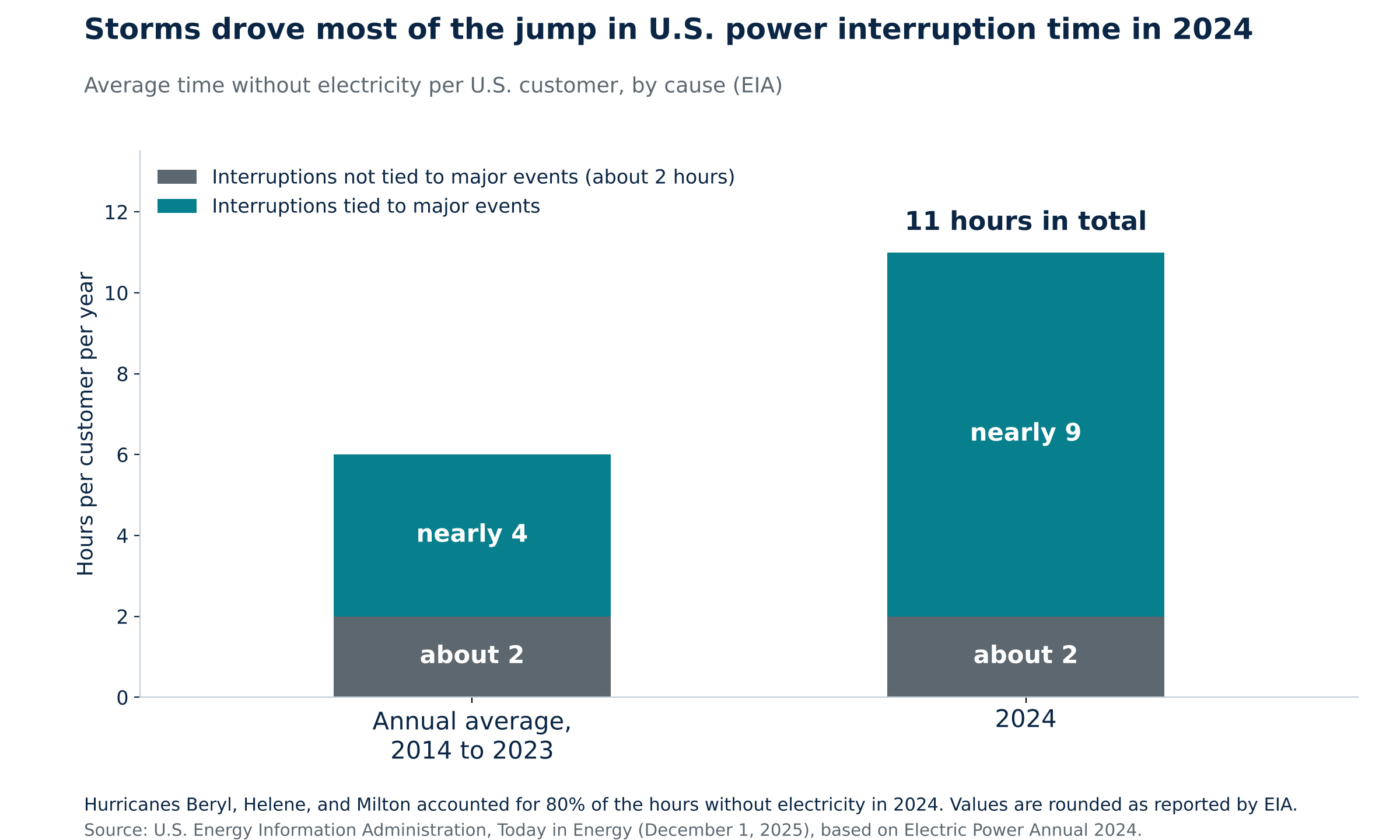
Figure 1. Average annual U.S. power interruption time per customer, by cause. Source: EIA (December 1, 2025). Values rounded as reported by EIA.
Technology failures can be costlier per hour. ITIC’s 2024 Hourly Cost of Downtime Survey, an independent web survey of more than 1,000 firms worldwide, found that a single hour of downtime exceeds $300,000 for over 90% of mid-size and large enterprises, a figure that excludes litigation and civil or criminal penalties.[3] These are survey results for mid-size and large enterprises, not insurance claim data, and should not be applied directly to smaller businesses, whose downtime costs will vary. ITIC also lists failure to track hourly downtime costs among the business-side human errors that contribute to downtime, which points to a planning gap many companies share.[3]
The July 2024 CrowdStrike incident shows how those costs reach insurance. Parametrix estimated direct financial losses of $5.4 billion for U.S. Fortune 500 companies, excluding Microsoft, from the global IT failure. It expected cyber insurance to cover no more than 10% to 20% of that amount, or $540 million to $1.08 billion, citing large risk retentions and low policy limits relative to the potential loss.[2]
Four Common Sources of Operational Interruption
- Utility service failure. Loss of electricity, water, or communications at the premises, whether the cause is a storm, a fault on the utility’s system, or a problem closer to the building.
- Technology and cloud failure. A faulty software update, a hosting or payment-platform problem, or an internal system fault that stops staff from working or customers from buying. Many of these events are non-malicious, which matters because cyber coverage is often discussed in terms of attacks.
- Supplier or customer disruption. A fire, flood, or shutdown at a key supplier, manufacturer, or customer location that interrupts the flow of materials or orders.
- Equipment failure at the business itself. A failed compressor, boiler, or control system can idle production even when the utility feed is intact. A guide on equipment breakdown coverage and the business risks it can help address explores how equipment failures can disrupt operations and create unexpected costs.
Weather connects several of these sources. A guide on why climate risk belongs in your insurance strategy encourages a closer look at changing weather exposure, which is a sensible lens for any business that depends on utilities, transport, or outside vendors.
Why Standard Property Coverage May Not Respond to Utility Failure
ISO’s Causes of Loss–Special Form, edition CP 10 30 10 12, is an open-peril form, but it carves out utility services. It excludes loss caused by the failure of power, communication, water, or other utility service supplied to the described premises, however caused, if the failure originates away from the premises, or originates at the premises but involves equipment used to supply the service from a source away from the premises. The form states that failure of any utility service includes lack of sufficient capacity and reduction in supply, and it also excludes loss from a surge of power that would not have occurred but for an event causing a power failure. If the failure or surge results in a covered cause of loss, the loss caused by that covered cause is still payable.[4]
Two endorsements add utility service interruption coverage, and each handles a different type of loss. Utility Services–Direct Damage (CP 04 17) covers direct physical loss or damage to covered property caused by an interruption of utility service to the described premises. The interruption must result from direct physical loss or damage by a Covered Cause of Loss to the utility property selected in the endorsement schedule.[13] For businesses with perishable inventory, separate Spoilage Coverage (CP 04 40) may also be relevant, subject to its own terms and conditions.[13] Utility Services–Time Element (CP 15 45) addresses lost business income or extra expense caused by an interruption of service to the premises, where the interruption results from direct physical loss or damage by a covered cause to the utility property selected on the schedule.[5]
The 09 17 edition of CP 15 45 carries details worth knowing before a loss. The buyer can select a waiting period for utility-related business income that is independent of the policy’s own waiting period, with options from none up to 168 hours. Eligible utility property covers water supply, wastewater removal, communication supply, and power supply, and overhead transmission lines are not included unless marked on the schedule. The endorsement does not apply to business income loss or extra expense tied to damage or corruption of electronic data, the coinsurance condition does not apply, and the utility services limit is part of, not in addition to, the limit stated in the declarations.[5] These details turn a vague answer, “we have business interruption coverage,” into a precise one.
How Business Income and Extra Expense Respond
Business income coverage is tied to physical loss. In the utility context, the interruption must result from direct physical loss or damage by a covered cause to the utility property named in the endorsement.[5] FC&S editors, writing about ISO’s business income form, explain that a 72-hour waiting period applies to each business income loss. It is not a deductible per se, but it is the portion of the loss the insured bears, and it applies in addition to any property deductible. After operations resume, the Extended Business Income additional coverage can provide up to 60 additional days to restore income to normal levels.[6]
The timing arithmetic is simple and unforgiving. If a power interruption lasts 60 hours and the applicable waiting period is 72 hours, no business income is payable for that event. With a 24-hour waiting period selected on the utility endorsement, the remaining 36 hours could fall within coverage, subject to the policy’s other terms. Under CP 15 45, extra expense begins at the time of interruption and business income begins after the waiting period. Coverage ends when operations are fully resumed by any means, or could be fully resumed by any means, whichever occurs first.[5]
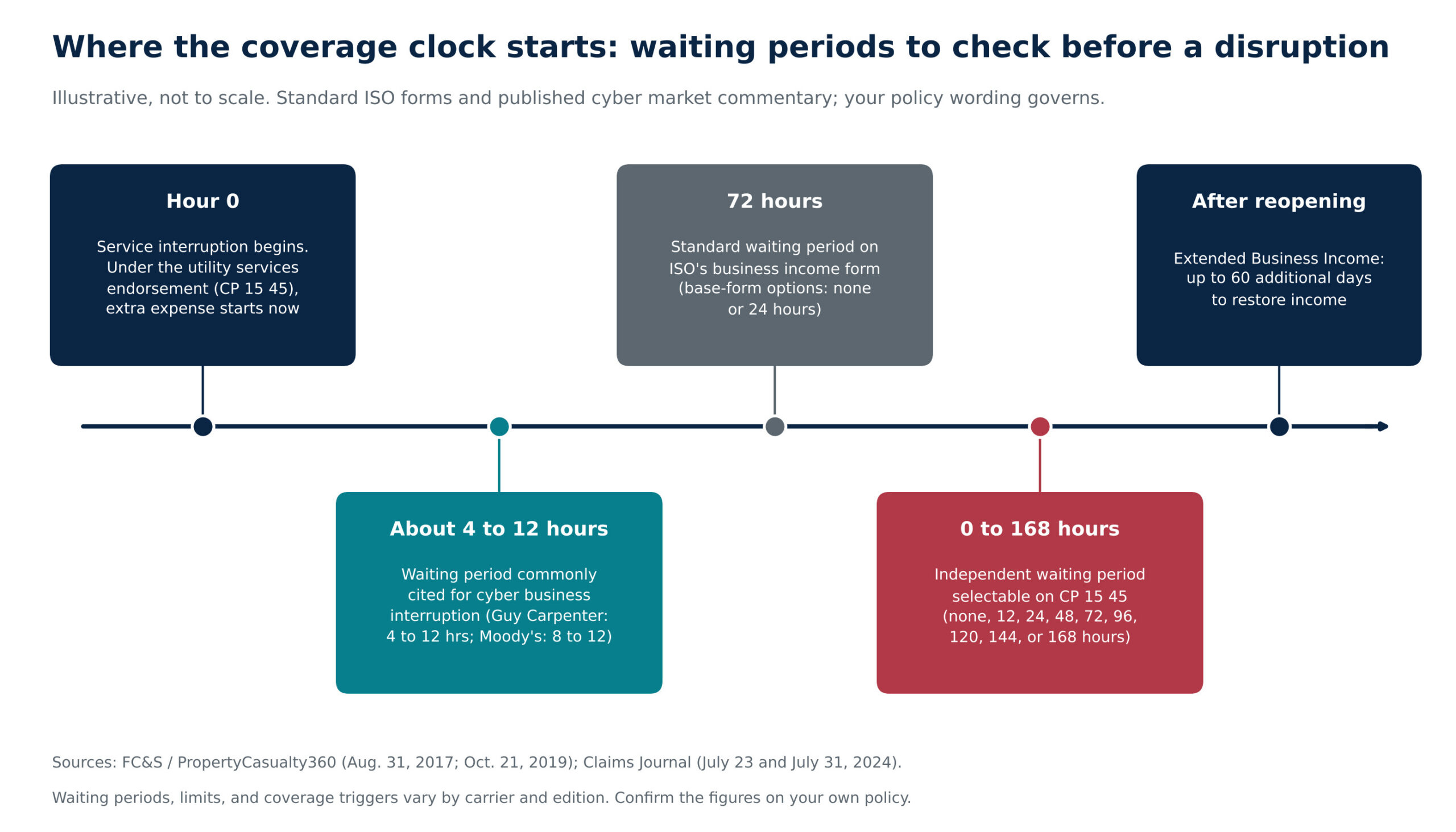
Figure 2. Waiting periods to check before a disruption. Illustrative, not to scale. Sources: FC&S (2017, 2019) and Claims Journal (July 2024).
Extra expense deserves equal attention, because the quickest way to shorten a disruption is often to spend money: renting a generator, relocating a process, or expediting a repair. A guide on extra expense costs businesses should plan for after a loss explains that a covered loss can create costs beyond the physical repair, and a guide on how property damage exposes businesses to financial loss examines property valuations, coverage limitations, and business interruption together.
Technology and Cloud Disruptions: Where Cyber Coverage Fits
A faulty software update or hosting problem, by itself, generally does not meet the physical loss or damage requirement for standard commercial property business interruption coverage. After the CrowdStrike incident, a DBRS Morningstar analyst said a typical business interruption policy within a regular commercial insurance program would not cover the resulting losses, and that not every cyber policy includes business interruption coverage, which may have to be bought separately at extra cost.[9]
Cyber policies can respond, but their wording varies. An Aon analysis of several leading cyber insurers’ policy wordings found a range of approaches to coverage triggered by system failure or non-malicious events. Some carriers include it in the standard form, others do not, and additions by endorsement or restrictions for certain industries are common.[7] Moody’s noted that cyber policies carry minimum waiting periods of between eight and 12 hours before a disruption triggers business interruption coverage, and that system failure from non-malicious acts may not be covered or may be subject to sublimits.[8] Guy Carpenter described waiting periods of four to 12 hours as most common, varying with industry class and organization size.[7]
Two features deserve a direct question at renewal. System failure coverage addresses an unplanned interruption of the insured’s own systems. Dependent, or contingent, business interruption addresses a failure at a vendor the business relies on. Moody’s expected claims from the CrowdStrike incident to include both direct losses from an insured’s own system failure and contingent business interruption caused by a vendor being affected.[8]
Technology vendors deserve their own risk review. A guide on third-party technology risks businesses should watch explores risks companies should consider when relying on outside technology providers. Scenario exercises help too: a guide on financial scenario planning for smarter risk decisions asks how a cyber incident would disrupt operations and cash flow and what a prolonged supply chain failure would cost.
Supplier and Customer Dependencies
Standard business income coverage generally does not automatically cover income losses caused by an interruption at a supplier or customer. Separate dependent property coverage may be needed to address those losses.[10,11] ISO offers two Business Income From Dependent Properties endorsements for the gap: the Broad Form (CP 15 08) and the Limited Form (CP 15 09). The Broad Form schedule identifies dependent properties by name, description, and location, and classifies them into four categories: contributing, recipient, manufacturing, and leader locations.[10]
The trigger still matters. The Broad Form requires that the suspension be caused by direct physical loss of or damage to dependent property at a premises described in the schedule, caused by or resulting from a covered cause of loss.[12] A supplier that closes for a reason unrelated to physical damage generally would not meet that test, which is why the dependent property schedule should name the suppliers and customers that matter most.
A Four-Step Plan: Map, Quantify, Align, Rehearse
This working framework, which is not an industry standard, turns the review into a repeatable process.
- List the utilities, software platforms, vendors, and equipment each critical function depends on, and mark which dependencies sit off premises. The map shows where a single point of failure could stop an entire operation.
- Estimate hourly and daily loss for each critical function: lost net income plus continuing payroll and fixed costs, with the extra expense of workarounds and any perishable inventory at risk listed separately. The number is needed to choose between waiting periods and to size limits. ITIC’s survey benchmarks apply to mid-size and large enterprises, so a smaller business should rely on its own financial records.[3]
- Compare the numbers with the policy. Does the property form carry CP 04 17 and CP 15 45 where power, water, or communications dependence is real? Does the cyber policy cover non-malicious system failure and dependent business interruption, and with what waiting period? A guide on how risk assessment reveals insurance gaps before they become costly shows how reviewing business exposures can uncover coverage gaps before renewal.
- Test the continuity plan and revisit it as staff, vendors, and systems change. A plan that sits untouched loses value quickly, as the continuity guide linked above notes. Keep dated records of equipment, photos, and financial statements that would support an income claim.
Practical Checklist Before Renewal
- Identify which utilities, platforms, and suppliers each critical function depends on.
- Confirm whether the property policy carries Utility Services–Direct Damage and Utility Services–Time Element, and which utilities, including overhead transmission lines, are scheduled.
- Check the business income waiting period and, where utility time element is endorsed, the independent waiting period selected.
- Ask whether extra expense coverage is included and whether limits reflect the cost of generators, temporary space, or expedited repairs.
- Confirm whether the cyber policy covers non-malicious system failure and dependent business interruption, and which waiting period applies.
- Check whether dependent property endorsements name the suppliers and customers that matter most.
- Review lease, lender, and customer contracts for required coverages, limits, and continuity obligations.
Common Missteps to Avoid
- Assuming business interruption covers every interruption. It generally follows physical loss, and utility and technology failures need specific endorsements or policies.
- Choosing a waiting period without knowing hourly loss. The first hours or days of a disruption are borne by the business, so the choice should rest on a calculated number.
- Overlooking limits. The utility services limit is part of, not in addition to, the premises limit, so a modest scheduled amount can cap recovery.
- Treating the continuity plan as finished. Staff turnover, new vendors, and new systems change what the plan must cover.
How a Broker Can Help You Close Interruption Coverage Gaps
Closing utility, technology, and dependency gaps takes judgment as well as data, and it works best when the first serious look at coverage does not happen after an outage. Infinity Insurance Partners is an insurance brokerage with offices in Scottsdale, Arizona and Albuquerque, New Mexico. Its property and casualty services include exposure analysis, retention analysis, claims analysis, loss control techniques, OSHA compliance and reporting, safety education and training, and the development of safety policies and programs.
The property and casualty services page outlines that scope, the loss control solutions page describes support for reducing losses, and the risk management page introduces the Risk Insights publication on issues affecting property and casualty insurance. The blog offers more guidance on continuity, claims, and coverage decisions. The services page also describes CSR 24, an around-the-clock service that includes access to proof of insurance certificates outside normal business hours.
Before a coverage review, be ready to share:
- A list of critical equipment, utilities, software platforms, and vendors, with the dependencies you identified.
- Your declarations, causes of loss form, and endorsements, including any utility services or dependent property endorsements, and your cyber policy.
- Financial records that show monthly revenue and fixed expenses, and your estimate of what an hour or a day of downtime costs.
Ready to test your coverage? Contact Infinity Insurance Partners to start a conversation about utility failure, technology disruption, and business income ahead of your next renewal.
Frequently Asked Questions
Does commercial property insurance cover a loss of power?
Not by default. ISO’s Causes of Loss–Special Form excludes failure of power, communication, water, or other utility service supplied to the premises, although loss from a covered cause of loss that results from the failure is still payable.[4] Utility Services–Direct Damage (CP 04 17) and Utility Services–Time Element (CP 15 45) add coverage when the interruption results from direct physical loss or damage by a covered cause to the utility property scheduled.[5,13]
What is a business income waiting period?
It is the period at the start of a loss for which the insured bears the income loss. On the ISO form it is 72 hours, it is not a deductible per se, and it applies in addition to any property deductible.[6] The utility services time element endorsement allows an independent waiting period from none up to 168 hours.[5]
Does cyber insurance cover a non-malicious IT failure?
It depends on the wording. Some carriers include system failure coverage in the standard form and others do not, and sublimits and waiting periods of several hours commonly apply.[7,8]
What is dependent business interruption coverage?
It addresses income loss that begins at a supplier, customer, or provider the insured depends on. In property programs it is provided by dependent property endorsements such as CP 15 08, which are triggered by direct physical loss at a scheduled dependent property.[10,12] In cyber programs, contingent business interruption claims arise when an insured’s vendor is affected.[8]
How can a business estimate the cost of downtime?
Start with the net income each critical function would lose per hour or per day, then add the operating expenses that continue during the shutdown, such as payroll and fixed costs. List the extra expense of workarounds and any perishable inventory at risk separately. Compare the totals with waiting periods and limits. ITIC’s benchmarks describe mid-size and large enterprises, so smaller businesses should rely on their own records.[3] An accountant or insurance broker can help confirm the figures.
Research and Further Reading
[3] ITIC: 2024 Hourly Cost of Downtime Report Part 1 (September 3, 2024).
[6] FC&S Editors, PropertyCasualty360: Common Issues in Business Income (October 21, 2019).
[10] Adjusters International, Adjusting Today: Contingent Dependent Properties Insurance.
[11] Adjusters International, Adjusting Today: Questions About Business Income Insurance.
Latest Posts

6 Trading Compliance Mistakes That Can Create Costly Business Exposures
Understand how regulatory obligations, internal controls, and operational oversight influence business risk, liability exposures, and insurance considerations.

How to Evaluate Agentic AI Without Overlooking Emerging Liability Exposures
Explore how autonomous business technologies introduce new liability considerations, accountability challenges, and coverage questions for growing organizations.

How to Address Insolvency Risk Before It Disrupts Your Operations
Understand how financial instability among vendors, contractors, and business partners can affect your operations and create unexpected financial exposure.